Help Center

Disinfectant wipes are among the most frequently used hygiene tools in commercial facilities, and among the most frequently misused. For facility managers overseeing gyms, schools, healthcare environments, or corporate offices, the gap between a wipe that looks like it’s working and one that’s actually disinfecting comes down to three factors: chemistry, substrate quality, and contact time. Understanding how these interact under real operating conditions is the difference between a compliant cleaning program and one that creates liability exposure.
This guide covers the science behind commercial disinfectant wipes so you can make informed purchasing decisions, build protocols that hold up under daily operational pressure, and select products that perform consistently across your facility.

What Are Disinfectant Wipes
Disinfectant wipes are pre-saturated cleaning cloths designed to remove soil and kill specified pathogens when used according to the labeled contact time. Their effectiveness depends on both the chemical formulation and the wipe material's ability to keep surfaces visibly wet long enough to achieve kill claims.
For a complete guide to EPA registration requirements, List N compliance, and eco-label certifications, see our EPA List N & Eco-Labels Explained guide.
Cleaning vs. Disinfecting: Two Processes Happening at Once
Disinfectant wipes perform two actions simultaneously:
Mechanical removal – The wipe fabric lifts sweat, oils, and organic debris from surfaces.
Chemical disinfection – The active ingredient kills microorganisms once the surface remains wet for the required time.
If soil isn't removed first, disinfectant chemistry can be reduced. If the surface dries too quickly, the kill claim may not be achieved.
In fact, research evaluating disinfectant wipes under realistic wiping conditions found that wipe formulation and moisture retention significantly influence microbial reduction when surfaces are wiped the way people wipe them in high-turnover environments.
This finding applies directly to high-traffic facilities (gyms, schools, healthcare settings, and offices) where speed matters more than perfect technique. Learn more about the difference between cleaning, disinfecting, and sanitizing.

Do Disinfectant Wipes Work Effectively?
Yes, but only when three conditions align: the substrate holds enough moisture through the full wipe-down, the surface stays wet for the required contact time, and soil doesn't block the chemistry from reaching the surface.
The problem in high-traffic facilities is that wipes often look like they're working when they're not. A wipe can remove visible dirt without killing pathogens if it dries out mid-use or if staff move on before contact time completes. That's why substrate quality and moisture retention matter as much as EPA-registered chemistry.
Contact Time: Where Protection Often Breaks Down
Every EPA-registered disinfectant has a required dwell (contact) time: the amount of time the surface must remain wet for the product to achieve its labeled kill claims.
In high-traffic facilities:
• Surfaces are reused quickly (gym equipment, classroom desks, exam tables)
• Airflow increases evaporation
• Users wipe and move on
A scientific review of disinfectant-impregnated wipes highlights how substrate durability, saturation level, and soil load all affect whether microbes are removed or unintentionally spread. Wipe chemistry alone does not determine effectiveness. Substrate durability, saturation level, and real-world usage conditions directly influence whether microbes are removed or transferred.

Choosing the Best Disinfectant Wipes for High-Traffic Facilities
Wipe selection should be driven by how your facility actually operates, not just by what a product spec sheet lists as the kill claim. Substrate quality, moisture retention, and contact time requirements determine real-world performance. When substrate construction is poor, EPA-registered chemistry cannot compensate for moisture loss or fiber breakdown mid-use.
Antibacterial Surface Wipes for General Commercial Use
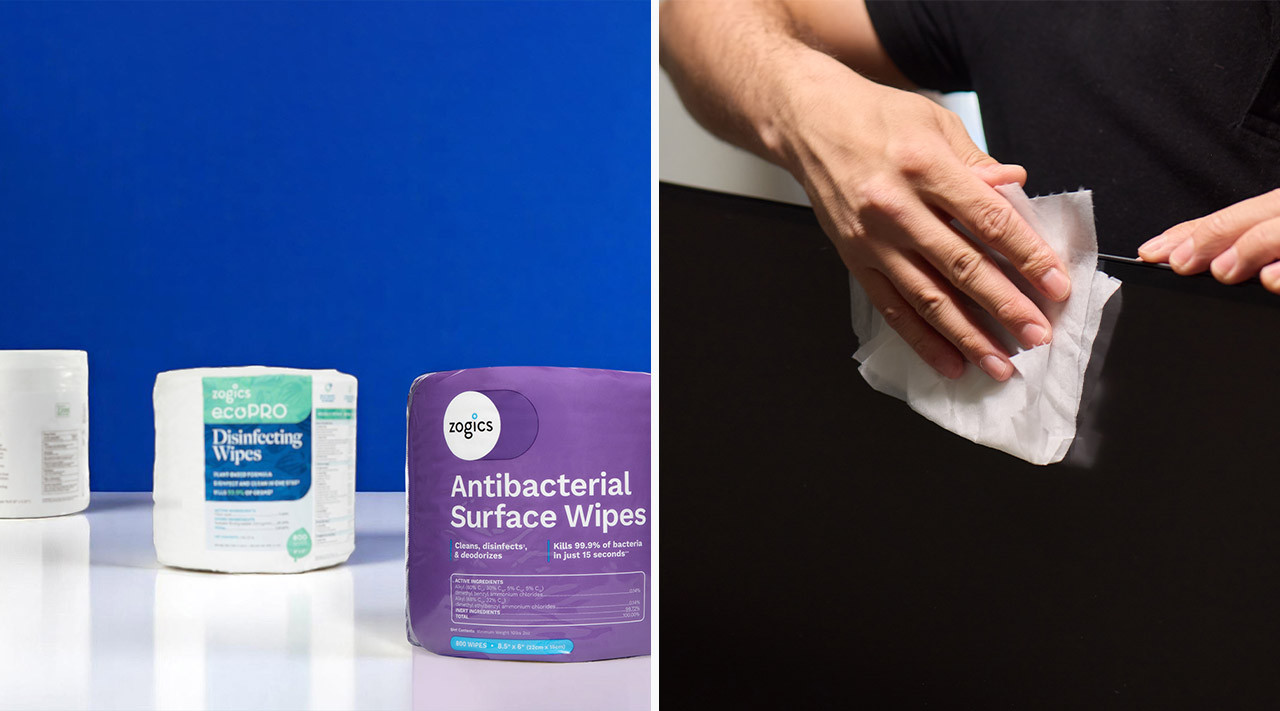
Antibacterial surface wipes with shorter contact times are practical for high-turnover environments. Zogics Antibacterial Disinfecting Wipes kill 99.9% of bacteria in just 15 seconds. These antibacterial wipes work on hard surfaces while remaining safe for electronics and screens.
Plant-Based Disinfectant Wipes for Sustainability-Focused Facilities
For facilities with documented sustainability commitments or green purchasing requirements, Zogics ecoPRO Plant-Based Disinfecting Wipes deliver disinfection using 100% biodegradable, botanically derived ingredients. DfE-certified, these bulk wipes are a practical option for K-12 schools, healthcare facilities, and operations with formal environmental procurement standards.

Bulk Disinfectant Wipes and System Design: How Supply Continuity Affects Compliance
Chemistry and substrate quality only matter if wipes are accessible and available when staff need them. In high-traffic facilities, compliance breaks down at the dispenser level more often than at the protocol level. Wipes that tear easily, dry out mid-roll, or require constant change-outs reduce compliance.
Well-designed systems reduce interruptions and support adequate wipe volume without adding labor.
Dispenser placement drives compliance. Whether you choose wall-mounted dispensers for high-traffic zones or freestanding floor stations for open areas, accessibility matters. For facilities looking for an all-in-one solution, The Cleaning Station combines wipe dispensing, waste disposal, and hand sanitizer in a single freestanding unit, promoting the complete hygiene workflow of Pull, Wipe, Toss, and Sanitize.
Proper capacity planning matters. Facilities that underestimate wipe volume often see dry rolls, member frustration, and compliance drops. Ordering bulk disinfectant wipes in multi-roll cases helps prevent stockouts.
Disinfectant Wipe Buyer's Evaluation Checklist
If you're evaluating disinfectant wipes for your facility, here's what to prioritize:
• Short contact times (15 seconds to 2 minutes for practical facility use)
• Durable material that holds up through full equipment wipe-downs
• Verified kill claims
• Alcohol, bleach, and phenol-free (safe for electronics and multiple surface types)
• Bulk case options to reduce staff restocking during peak hours
• Consistent saturation level – wipes should not dry out mid-roll under normal storage conditions
Evaluate commercial disinfectant wipe systems that align with your facility's contact time requirements, traffic volume, and procurement strategy. Speak with a Zogics product specialist to standardize wipe systems across locations and reduce operational friction.
Zogics is a trusted supplier of professional cleaning and disinfecting solutions for gyms, fitness studios, schools, healthcare facilities, and commercial properties. We work with single-location studios and national franchise chains to keep high-traffic spaces clean, safe, and compliant.