




Quick answer
Powder is better for: heavy dirt, mud, clay, and grass stains — cost per load at commercial scale — longer shelf life — recyclable packaging.
Liquid is better for: grease, oil, and body sweat stains — cold-water washing — HE machine compatibility — pre-treating stains directly on fabric.
For most commercial facilities (gyms, hotels, healthcare): liquid wins on versatility and HE compatibility. Powder wins on cost per load when buying in bulk for high-volume operations with hot-water machines.
When operating a gym, hotel, or commercial facility, choosing the right detergent isn't just about clean laundry — it's about maintaining operational efficiency, controlling costs, and ensuring customer satisfaction.
Both powder and liquid detergents have their own advantages, depending on factors like cost per load, packaging, and how they perform in different washing conditions. For many business owners, the question becomes: is powder or liquid detergent better for daily operations?
When comparing powder vs liquid detergent, it's important to understand how each option works, where one may outperform the other, and which delivers the best value at scale. Let's break down the differences and help you decide which solution makes the most sense for your business.
Powder vs Liquid Detergent: Head-to-Head Comparison
The table below covers every major factor commercial facility managers consider when choosing between powder and liquid detergent at scale.
| Category | Powder detergent | Liquid detergent |
|---|---|---|
| Cost per load | Lower — typically 20–30% cheaper per load at commercial volume | Higher — water content increases weight and shipping cost |
| Best stain type | Mud, clay, grass, blood, ground-in dirt | Grease, oil, body sweat, food residue, makeup |
| Water temperature | Best in warm or hot water — may leave residue in cold | Works in all temperatures including cold |
| HE washer compatibility | Compatible if HE-labeled — risk of residue buildup in drum | Preferred for HE machines — low-suds, no residue |
| Shelf life | Up to 2 years or more if kept dry | 6–12 months — degrades faster due to water content |
| Pre-treating stains | Can be mixed with water to form a paste for direct application | Apply directly to fabric — faster and easier for staff |
| Hard water performance | May underperform — minerals interfere with dissolving | Less affected by hard water — dissolves consistently |
| Septic system safety | Some fillers and clay-based agents can cause buildup over time | Generally safer — dissolves fully, no solid residue |
| Storage at scale | Compact, stackable, takes less space per load count | Heavier and bulkier per load count |
| Packaging / sustainability | Typically recyclable cardboard — lower plastic use | Usually plastic bottles — more eco-friendly formulas available |
| Measuring accuracy | Easy to measure precisely — reduces waste | Over-pouring common without measured caps |
| Whites / brightening | Often contains enzymes and whitening agents — better for whites | Effective but fewer whitening additives in most formulas |
What Are Powder Detergents?
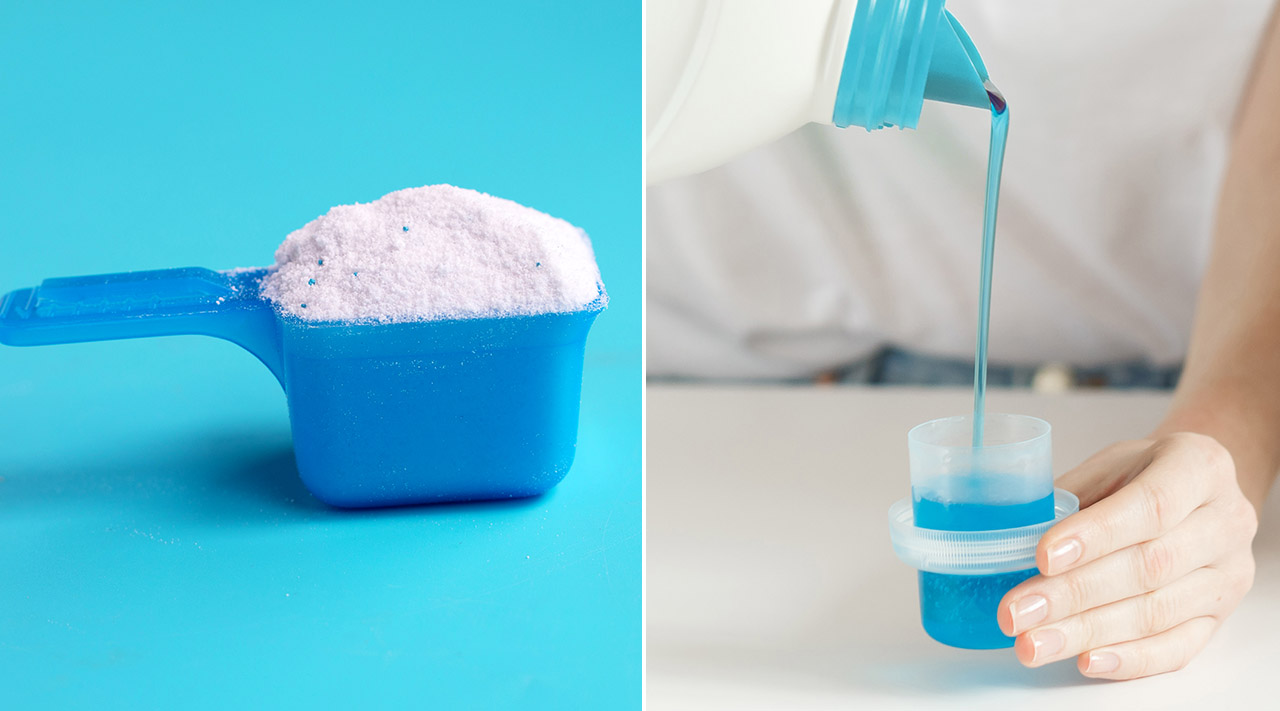
Powder detergents are traditional, granulated cleaning agents. They're highly effective for lifting tough stains and are often preferred for industrial and commercial use due to their cost-effectiveness and shelf life.
What Are Liquid Detergents?
Liquid detergents are concentrated, liquid-based cleaners that easily dissolve in water. They're favored for their ease of use, especially in low-temperature washes and for treating grease and oily stains. Liquid laundry detergents are particularly effective for grease and oil stains due to their formulation.
Is Powder or Liquid Detergent Better?
When comparing powder vs liquid detergent, the better option depends on how and where the detergent is being used. For many commercial and business environments, the decision often comes down to performance, cost efficiency, and operational needs.
Liquid detergent is generally better for tackling greasy or oily stains, making it a strong choice for facilities like gyms, hotels, and healthcare settings where body oils and heavy soils are common.
Powder detergent, on the other hand, tends to offer better value per load and a longer shelf life. It performs especially well on ground-in dirt and clay-based stains and is often preferred by businesses looking to reduce packaging waste and lower overall detergent costs.
Cleaning Performance: Powder vs Liquid
Effectiveness on Different Stains
| Stain type | Powder detergent | Liquid detergent |
|---|---|---|
| Mud / clay / dirt | Excellent — surfactants break down ground-in particles | Good |
| Grease / oil / body sweat | Moderate | Excellent — penetrates oily residue directly |
| Grass / blood | Excellent — enzyme formulas target organic stains | Good |
| Food / sauces | Good | Excellent — effective pre-treater applied directly |
| Whites / brightening | Excellent — often contains whitening agents and enzymes | Good |
| Delicates / colors | Use with caution — residue risk in cold water | Excellent — dissolves fully, safer for sensitive fabrics |
Water Temperature
| Water temperature | Powder detergent | Liquid detergent |
|---|---|---|
| Cold water (below 60°F) | May not dissolve fully — risk of white residue on dark fabrics | Dissolves completely — preferred choice |
| Warm water (60–90°F) | Good performance — recommended minimum for powder | Excellent performance |
| Hot water (above 90°F) | Excellent — optimal dissolving and cleaning | Excellent performance |
Cost Comparison
| Cost factor | Powder detergent | Liquid detergent |
|---|---|---|
| Cost per load | Lower — typically 20–30% cheaper | Higher — water content adds weight and cost |
| Bulk buying | Easier to store in bulk — lighter, more compact | Heavier and bulkier per load equivalent |
| Shelf life | 2+ years if stored dry | 6–12 months |
| Waste / overdosing risk | Low — easy to measure precisely | Higher — over-pouring common without measured caps |
| Shipping cost | Lower — lighter weight per load count | Higher — water weight increases freight cost |
HE Washer Compatibility
High-efficiency (HE) washing machines are standard in most commercial laundry operations — gyms, hotels, healthcare facilities, and schools all rely on HE machines for their lower water consumption and faster cycle times. Choosing the wrong detergent type is one of the most common and costly mistakes in commercial laundry management.
HE machines use significantly less water than standard washers — typically 10–15 gallons per cycle vs 40+ gallons in traditional top-loaders. This means detergent is more concentrated in the wash water, and any excess suds have nowhere to go. The result is oversudsing, longer rinse cycles, higher utility costs, and detergent residue left in fabrics and the drum.
| Factor | Powder in HE machines | Liquid in HE machines |
|---|---|---|
| HE compatibility | Compatible only if labeled HE — check packaging before use | Most liquid detergents are HE compatible — check for HE symbol |
| Dissolving in low water | Risk of incomplete dissolving — granules may remain on fabrics or in drum | Dissolves immediately — no residue risk |
| Sudsing risk | Low if HE-labeled — non-HE powder causes serious oversudsing | Low — HE liquids are formulated as low-suds |
| Drum buildup over time | Higher risk — undissolved granules accumulate in drum seals and dispensers | Lower risk — liquid passes cleanly through the system |
| Dispenser drawer use | Goes in the powder/pre-wash drawer — clumping can block the drawer in humid environments | Goes in the liquid detergent drawer — flows cleanly |
| Cold water HE cycles | Not recommended — HE cold cycles use minimal water, worsening dissolving issues | Ideal — dissolves fully regardless of water temperature |
| Recommendation for commercial HE | Use only if hot-water cycles are standard and HE label is confirmed | Preferred default for all commercial HE operations |
Bottom line for commercial HE machines: liquid detergent is the safer and more consistent choice. If your facility uses powder in HE machines, ensure it carries the HE symbol, run warm or hot cycles only, and clean the dispenser drawer monthly to prevent clumping and blockages.
Hard Water Considerations
Hard water can affect detergent performance. Powder detergents may not dissolve as well, while liquid detergents are less affected and can provide better stain removal.
| Water hardness | Powder detergent | Liquid detergent |
|---|---|---|
| Soft water | Performs well — no adjustment needed | Performs well |
| Hard water | May underperform — minerals interfere with dissolving and cleaning | Preferred — dissolves consistently regardless of mineral content |
| Very hard water | Not recommended without a water softener additive | Use liquid with a water softener additive for best results |
Best Use Cases: Powder vs Liquid
| Use case | Better choice | Reason |
|---|---|---|
| Gym / fitness center towels | Liquid | Body oils and sweat require a detergent that penetrates fabric fibers — liquid outperforms powder on oily residue |
| Hotel / hospitality linens | Both | Liquid for body oil on bedding; powder for whitening and brightening towels in hot-water cycles |
| Healthcare / clinical | Liquid | Cold-water compatibility and no residue risk are critical — liquid is the safer default in clinical settings |
| School / education uniforms | Powder | Mud, grass, and clay stains are common — powder's cost per load advantage matters at high volume |
| Food service / kitchen | Liquid | Grease and food oil dominate — liquid penetrates and breaks these down faster |
| HE commercial machines | Liquid | Lower suds, no dissolving issues, no drum buildup — the consistent choice for HE operations |
| High-volume cost control | Powder | 20–30% lower cost per load at bulk pricing — meaningful savings across hundreds of weekly loads |
| Cold water washing | Liquid | Powder risks incomplete dissolving in cold cycles — liquid is the only reliable option |
Environmental Impact
| Factor | Powder detergent | Liquid detergent |
|---|---|---|
| Packaging | Usually recyclable cardboard — lower plastic waste | Usually plastic bottles — recycling depends on local program |
| Shipping footprint | Lower — less weight per load count reduces transport emissions | Higher — water content increases shipping weight |
| Eco-friendly formulas | Available — biodegradable, phosphate-free options | Available — wide range of plant-based, biodegradable formulas |
| Septic safety | Some fillers can accumulate — choose septic-safe labeled products | Generally safer — dissolves fully with no solid residue |
At Zogics, we offer septic-safe, eco-conscious detergents for commercial facilities.
Explore Our Commercial Detergent Solutions
Looking for high-quality powder or liquid detergents for your facility?
Shop Commercial Laundry Detergents
Frequently Asked Questions
Is powder or liquid detergent better for HE washers?
Liquid detergent is the preferred choice for HE washers. HE machines use significantly less water per cycle, which increases the risk of powder detergent not dissolving fully — leaving granule residue on fabrics and in the drum over time. Liquid detergent dissolves immediately in any water temperature and produces low suds that HE machines are designed for. If you use powder in a commercial HE machine, confirm it carries the HE label and run only warm or hot cycles.
Can you mix powder and liquid detergent?
It's not recommended. Mixing can lead to over-sudsing, poor rinsing, or residue — especially in high-efficiency machines. If switching from one type to the other, run an empty rinse cycle first to clear the drum and dispenser drawer of any remaining product.
Which detergent type is better for sensitive skin?
Liquid detergent generally offers more fragrance-free and hypoallergenic options, making it the more common choice for facilities serving guests with sensitive skin — hotels, spas, and healthcare environments. For either type, choose fragrance-free formulas and follow recommended dosing to reduce residue on fabrics, which is the primary irritant.
Is powder detergent better than liquid for cold water?
No. Powder detergent is at a significant disadvantage in cold water — it may not dissolve fully, leaving white residue on dark fabrics and buildup in the machine. Liquid detergent is the only reliable choice for cold-water washing cycles.
Which is cheaper — powder or liquid detergent?
Powder detergent is typically 20–30% cheaper per load than liquid at commercial bulk pricing. It also has a longer shelf life (2+ years vs 6–12 months for liquid) and is lighter to ship, which reduces freight costs. For high-volume operations running hot-water cycles, powder offers meaningful cost savings at scale.
Final Thoughts
Choosing between powder and liquid detergent depends on your facility's needs — the type of stains you're dealing with, your machine type, water temperature, and volume.
Whatever your choice, we're here to help you find the best commercial laundry detergent for your business.