Help Center

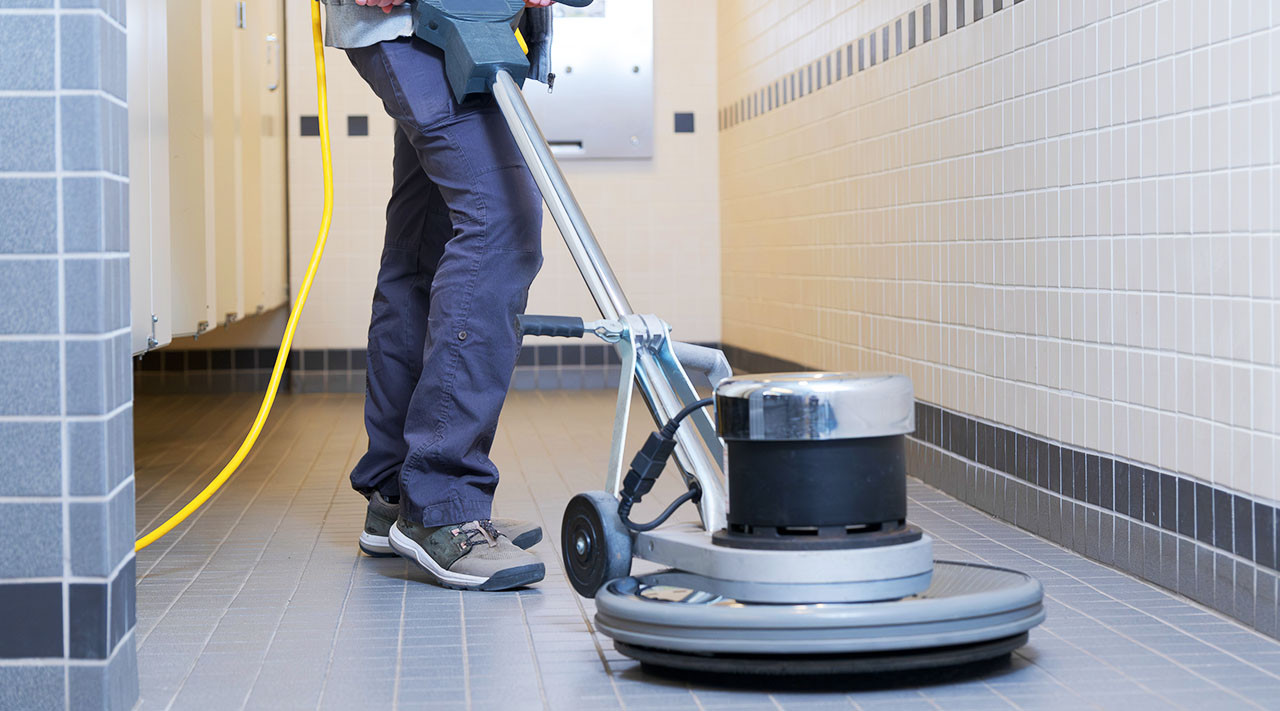
Quick Answer
What It Is: A cleaning chemical formulated for high-traffic commercial flooring, sold as a concentrate and matched to a floor type by pH.
The Four Types: Neutral (pH 6–8), alkaline (9–12), acidic (1–5), and enzymatic.
The Safe Default: A neutral cleaner. It works on every sealed floor and damages none of them.
The Costly Mistake: Acid on marble or terrazzo etches it permanently. Alkaline on natural stone dulls it.
Cleaner vs Machine: The cleaner is the chemistry, the scrubber is the delivery. You choose the chemical by floor type and the machine by floor area.
Picking the right commercial floor cleaner is not about finding the strongest product. It is about matching pH to flooring material. Get that wrong and you can permanently etch a stone floor, dull a finish, or degrade rubber — with a product that is working exactly as designed, just on the wrong surface.
This guide covers what a commercial floor cleaner is, the four types by pH, which cleaner is safe on which floor, use cases by industry, and the machines that apply them.
What Is a Commercial Floor Cleaner?
A commercial floor cleaner is a cleaning chemical formulated for the volume, soil load, and durability demands of commercial flooring. It is almost always sold as a concentrate that dilutes into working solution, and it is classified by pH — neutral, alkaline, or acidic — plus enzymatic formulas that work by a different mechanism entirely.
Three things separate a commercial floor cleaner from a household one:
- It is concentrated. You buy a gallon and it becomes 16 to 128 gallons of working solution, which is why cost is measured per diluted gallon rather than per bottle.
- It is rinse-free or low-residue. Residue is what makes commercial floors look hazy and, worse, turns them slippery.
- It states a pH. That single number tells you what it will clean and what it will damage.
Commercial floor cleaners are used across healthcare, hospitality, education, fitness, food service, and manufacturing. Whether you need to tackle tough stains or maintain delicate surfaces, there is a formulation designed for the job.
Types of Commercial Floor Cleaners
There are four types: neutral, alkaline, acidic, and enzymatic. Neutral is the daily driver, alkaline cuts grease, acidic dissolves mineral scale, and enzymatic digests organic odor sources. The table below is the whole decision in one place.
| Type | pH Range | Best For | Never Use On | Example |
|---|---|---|---|---|
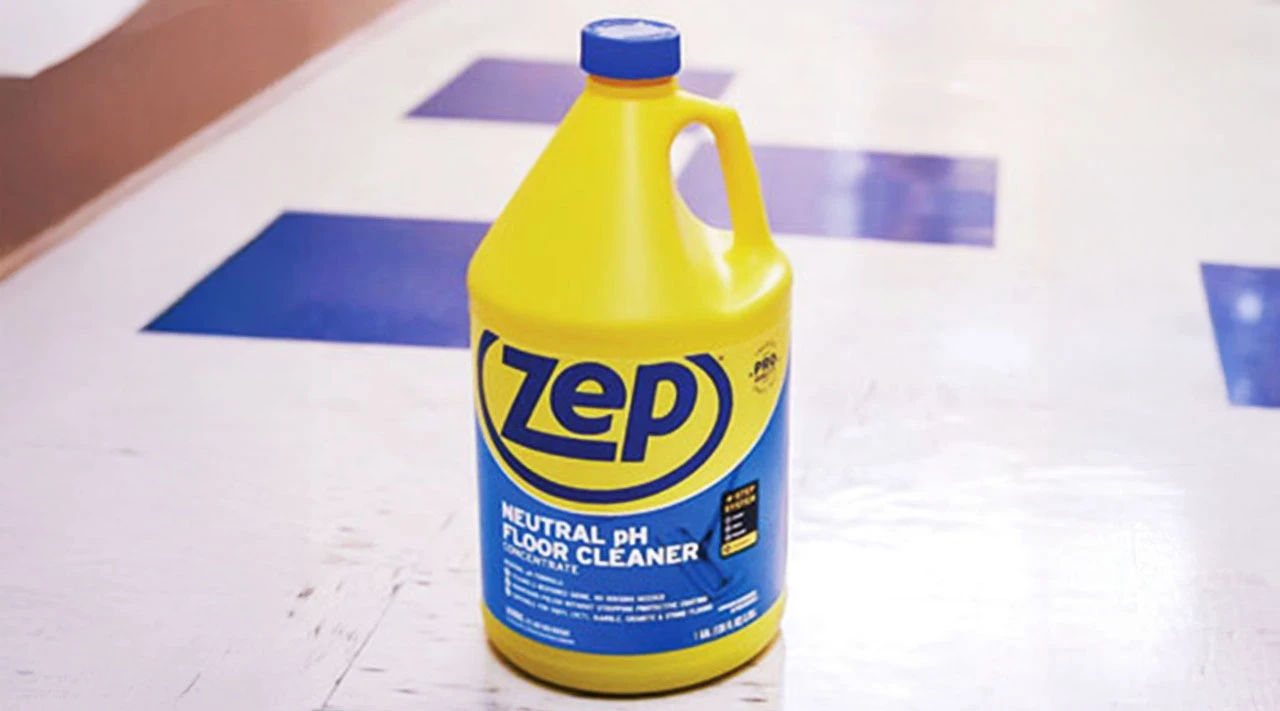
| Neutral | 6–8 | Daily maintenance on any sealed floor — hardwood, marble, vinyl, sealed concrete | Nothing. It is the safe default | Zogics All Surface Neutral Cleaner |
| Alkaline | 9–12 | Grease, oil, and organic soil on concrete, quarry tile, and industrial floors | Natural stone, unsealed wood, waxed or finished floors | Zogics Peroxide Powered Cleaner Degreaser |
| Acidic | 1–5 | Mineral scale, rust, efflorescence, uric salts, and grout haze | Marble, limestone, travertine, terrazzo — it etches them permanently | Zogics Organic Acid Restroom Cleaner |
| Enzymatic | Near neutral | Organic odor sources — urine, food, sweat — especially in grout and porous floors | Mineral scale or heavy grease. Wrong mechanism for both | Zogics Enzyme Enriched Floor Cleaner |
Neutral Floor Cleaners: Versatility and Safety
Neutral cleaners are the reliable everyday solution. They are gentle enough for delicate surfaces like hardwood and marble but still get the job done, and they rinse without leaving residue. If you are running one product across a mixed-flooring building, this is it — a neutral floor cleaner is the only category that is safe everywhere.
Alkaline Floor Cleaners: Heavy-Duty Stain Removal
When you are dealing with tough grease and organic stains, alkaline cleaners are the heavy hitters. These are what you want in industrial settings, kitchens, and loading docks where regular cleaners will not cut it. They are especially good on concrete. The trade-off is that the same alkalinity that lifts grease will dull natural stone and strip a floor finish.
Acidic Floor Cleaners: Tackling Tough Inorganic Stains
For rust, hard-water scale, efflorescence, and uric salts, acidic cleaners are the specialists. They dissolve mineral deposits that no amount of scrubbing with a neutral cleaner will shift. Use them carefully and never on calcium-based stone — marble, limestone, and terrazzo react with acid, and the etching is permanent.
Enzymatic Cleaners: Addressing Organic Odor at the Source
Enzymatic cleaners work by a different mechanism: they digest organic residue rather than dissolving it chemically. That makes them the right answer for odor problems in grout, rubber flooring, and unfinished concrete, where the smell comes from residue trapped in a porous surface. Note that they clean and deodorize but do not disinfect — see our guide on enzyme cleaners vs disinfectants.
Which Floor Cleaner Is Safe for Which Floor?
Match the chemistry to the flooring material before you consider anything else. This is the table that prevents expensive mistakes — most floor damage from cleaning is a pH problem, not a technique problem.
| Floor Type | Use | Avoid | Why |
|---|---|---|---|
| Sealed Hardwood | Neutral, damp mop only | Alkaline, acidic, standing water | Strips the finish and swells the boards at the seams |
| Marble, Limestone, Travertine | Neutral only | Anything acidic; strong alkaline | Calcium carbonate reacts with acid. Etching cannot be cleaned off, only refinished |
| Terrazzo | Neutral | Acidic cleaners | Contains marble chips, so it etches like stone |
| Ceramic and Porcelain Tile | Neutral daily; alkaline periodically; acidic for scale | Acid on unsealed grout, repeatedly | The tile tolerates almost anything. The grout is the vulnerable part |
| Sealed and Polished Concrete | Neutral daily; alkaline degreaser as needed | Strong acid on polished concrete | Acid dulls the polish and can open the surface back up |
| Rubber Gym Flooring | Rubber-specific neutral cleaner | Solvent degreasers, high-pH strippers | Degrades and discolors the rubber over time |
| Vinyl and LVT | Neutral | High-alkaline strippers, unless you are stripping | Dulls the wear layer and can lift the seams |
| Carpet | Extraction detergent; enzymatic for organic spills | Hard-floor cleaners of any pH | Leaves residue that attracts soil and re-soils faster |
The rule of thumb: if you do not know what the floor is or what pH is safe, use a neutral cleaner. It is the only category that cannot damage a sealed surface.
Use Cases of Commercial Floor Cleaners by Industry
The right product depends on what is actually landing on your floor. Grease, mineral scale, and organic odor are three different problems, and each industry tends to have one dominant one.
| Industry | Main Challenge | Primary Cleaner | Add for Problem Zones |
|---|---|---|---|
| Healthcare | Compliance plus organic spills | Neutral daily | An EPA-registered disinfectant for hygiene; enzymatic for organic residue |
| Hospitality | Appearance and entryway grit | Neutral | Alkaline degreaser in kitchens; acidic for restroom scale |
| Fitness and Gyms | Rubber flooring plus sweat odor | Rubber-specific neutral cleaner | Enzymatic for odor trapped in grout and mats |
| Education | Volume on a fixed budget | Neutral concentrate | Alkaline for cafeterias and gym entries |
| Food Service | Grease and slip risk | Alkaline degreaser | Enzymatic on floor drains to stop odor at source |
| Manufacturing and Warehouse | Oil and grease on concrete | Alkaline degreaser | Ride-on scrubber for coverage speed |
| Restrooms (Any Sector) | Uric scale and persistent odor | Acidic for scale | Enzymatic around toilet bases and grout lines |
Types of Floor Cleaning Machines
The cleaner is the chemistry; the machine is the delivery. Choose the chemical by floor type and the machine by floor area — those are two independent decisions.
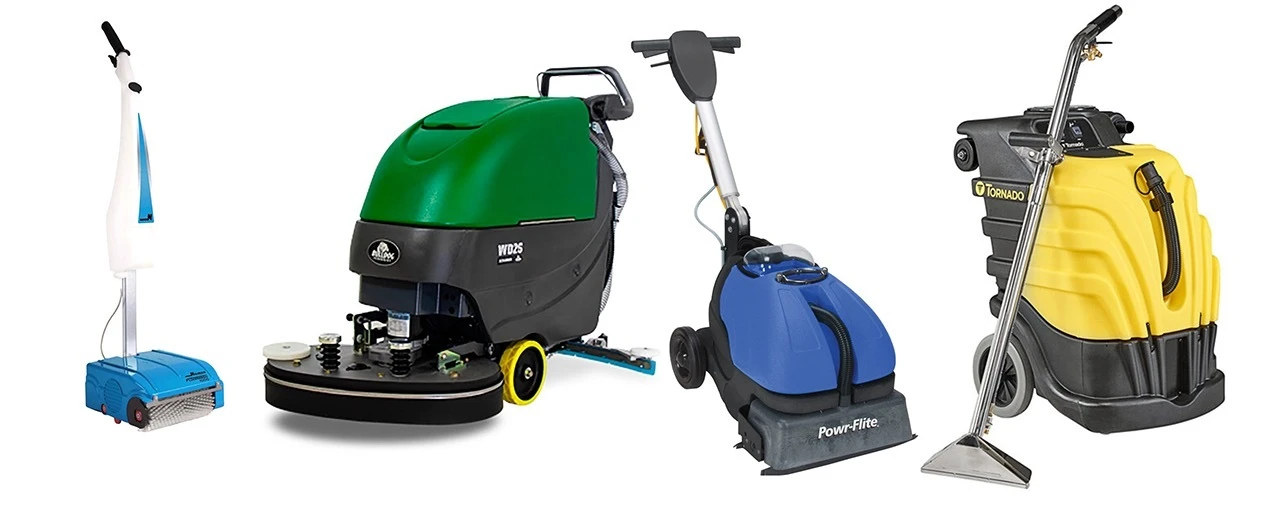
| Machine | What It Does | Best Area Size | Surface |
|---|---|---|---|
| Walk-Behind Scrubber | Scrubs and recovers solution in one pass; manoeuvrable in tight spaces | Small to medium | Hard floors |
| Stand-On Scrubber | Faster coverage with better cleaning pressure than walk-behind | Medium | Hard floors |
| Ride-On Scrubber | High-speed cleaning across open floor, often with traction drive | Large open areas | Hard floors |
| Sweeper | Removes loose dust and debris before any wet cleaning | Any | Hard floors and carpet |
| Burnisher | Polishes a finished floor to high shine. Does not clean | Any | Sealed or finished hard floors |
| Vacuum | Extracts dry soil from soft flooring | Any | Carpet |
| Carpet Extractor | Injects and recovers solution to deep clean and lift stains | Any | Carpet |
How Floor Scrubbers Work
A floor scrubber dispenses water and cleaning solution onto the floor, agitates it with a rotating brush or pad, then vacuums the dirty solution back up through a squeegee in the same pass. That recovery step is what separates a scrubber from a mop — a mop redistributes dirty water, a scrubber removes it.
Adjustable brush pressure and traction drive let you tune performance to the surface. To learn more, see what a commercial floor scrubber does.
Choosing the Right Floor Cleaner and Equipment
Work through it in this order: identify the flooring material, then the dominant soil, then the pH that is safe, then the machine that fits the square footage. Reversing that order is how facilities end up with a powerful machine applying the wrong chemical.
Understanding Your Floor Type and Its Unique Needs
Every floor has different tolerances. Hardwood needs different care than tile, and polished concrete needs something else again. Identifying the material — and whether it is sealed — is the first decision, because it rules out entire chemical categories before you compare products.
pH Levels, Material Compatibility, and Usage Frequency
pH is the single most useful number on a floor cleaner label. A cleaner that works wonders on greasy concrete will be too harsh for marble. Frequency matters too: high-traffic areas need daily neutral cleaning with periodic deep cleaning, not aggressive chemistry every day. Daily use of a strong alkaline cleaner will wear a finish faster than the traffic does.
Environmental Impact and Cost per Diluted Gallon
Concentrates are both the greener and the cheaper option, because you are not shipping water. Compare products on cost per diluted gallon rather than per bottle — a concentrate diluting at 1:128 can cost a fraction of a ready-to-use product per unit of working solution.
For context on where the category is heading, the global floor cleaners market was valued at about $6.62 billion in 2025 and is projected to reach $9.67 billion by 2034, a CAGR of 4.3%, with growth driven by hygiene standards and demand for sustainable formulations (Straits Research).
Maintenance and Best Practices
Sweep or dust mop before any wet cleaning, clean daily with neutral, and reserve aggressive chemistry for scheduled deep cleans. Most floor damage comes from doing heavy-duty cleaning too often, not too rarely.
Creating a Regular Cleaning Schedule
- Daily: Dust mop or sweep, then damp mop or scrub with a neutral cleaner.
- Weekly: Detail edges, corners, and grout lines where soil accumulates out of the traffic path.
- Monthly: Deep clean with the appropriate specialty chemistry — alkaline for grease, acidic for scale, enzymatic for odor.
- Annually or as needed: Strip and refinish floors that carry a finish.
Removing grit daily is the highest-value habit on that list. Grit under foot traffic acts like sandpaper, and it does more damage to a floor finish than any cleaner will. Stock the right cleaning tools and the daily pass gets faster.
Troubleshooting Common Issues
| Problem | Likely Cause | Fix |
|---|---|---|
| Hazy or Dull Film | Over-concentration or insufficient rinsing | Dilute to label rate and rinse. More product is not more clean |
| Slippery Floor After Cleaning | Residue left behind | Switch to a low-residue neutral cleaner and rinse. This is a liability issue, not cosmetic |
| Odor Returns Within Hours | Organic residue in a porous surface | Switch to enzymatic on grout, drains, and toilet bases |
| Etched or Whitened Stone | An acidic cleaner used on calcium-based stone | Cannot be cleaned off. Requires refinishing. Switch to neutral immediately |
| Grout Darkening | Mop water redepositing soil into porous grout | Use a scrubber with solution recovery, or change mop water more often |
Final Thoughts on Commercial Floor Care
Most floor damage attributed to heavy traffic is actually chemical. Match pH to the flooring material, use neutral daily, save aggressive chemistry for scheduled deep cleans, and sweep before you ever put water down.
Not sure which pH your floors can tolerate? Browse floor and carpet care and cleaning chemicals, or call 888.623.0088 and we will match products to your flooring materials and square footage.