Help Center

Quick Answer
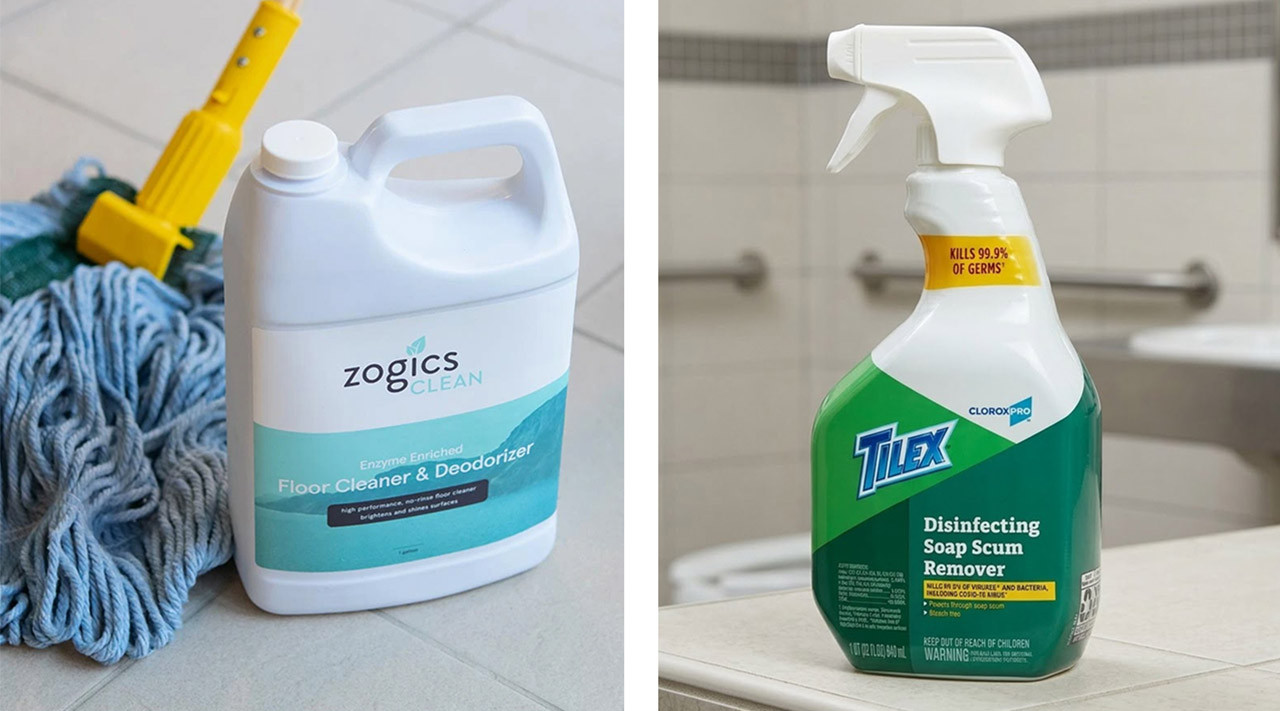
The Difference: An enzyme cleaner digests the organic residue that causes odor. A disinfectant kills bacteria and viruses on the surface.
For Odor: Enzyme cleaner. A disinfectant kills germs but leaves behind the residue actually producing the smell.
For Compliance: Disinfectant. Only an EPA-registered product can be used to document hygiene.
Do Enzyme Cleaners Disinfect: No. Under FIFRA, any product claiming to disinfect must be EPA-registered. Enzyme cleaners are not.
Use Them Together: Enzyme first to remove the source, disinfectant second for hygiene. Never the other way around.
Enzyme cleaner vs disinfectant is not a choice between two versions of the same thing. They solve different problems, and confusing the two is the most common reason odor complaints keep coming back.
A restroom gets disinfected three times a day, but the smell returns within an hour. Locker rooms are wiped down after every class, but carry a sweaty smell by mid-afternoon. Trash areas get sprayed nightly, but the odor never fully disappears.
The cleaning is happening. The staff is showing up. The problem is using the wrong product for the job.
Enzyme Cleaner vs Disinfectant: What Is the Difference?
An enzyme cleaner breaks down the organic matter that causes odors. A disinfectant kills bacteria and viruses on surfaces. Enzymes remove the source; disinfectants kill what is living on top of it. Neither one does the other's job, which is why most commercial facilities need both.
| Factor | Enzyme Cleaner | Disinfectant |
|---|---|---|
| What It Does | Digests proteins, fats, and organic waste | Kills bacteria and viruses on contact |
| Primary Job | Odor elimination at the source | Pathogen control and hygiene |
| EPA Registration | Not registered, not required | Required, with a registration number on the label |
| When It Works | Keeps working after application until the substrate is gone | Only during the labelled wet contact time |
| Porous Surfaces | Penetrates grout, concrete, and rubber flooring | Labelled for hard, non-porous surfaces only |
| Effect on Odor | Removes the source, so the smell does not return | Kills germs but leaves the residue behind |
| Compliance Value | Cannot be used to document disinfection | Satisfies hygiene and inspection requirements |
| Typical Cost in Use | $0.22–$1.75 per diluted gallon depending on duty level | Varies by concentration; compare per diluted gallon, not per bottle |
| Order of Use | First — removes the organic layer | Second — now it can reach the surface |
The short version: if the complaint is a smell, reach for the enzyme cleaner. If the requirement is documented hygiene, reach for the disinfectant. If you have both problems, run them in that order.
Do Enzyme Cleaners Disinfect?
No. Enzyme cleaners do not disinfect. They break down the organic matter that bacteria feed on, and peer-reviewed research shows they can disrupt biofilm. But they are not tested, registered, or legally permitted to make disinfection claims, and they cannot be used to meet a hygiene or inspection requirement.
This is not a marketing distinction. It is a regulatory one, and it is the reason enzyme cleaner labels are worded the way they are.
Enzyme Cleaners Are Not Disinfectants: Here Is the Source
The authority is the US Environmental Protection Agency, under the Federal Insecticide, Fungicide, and Rodenticide Act (FIFRA). EPA's guidance on determining if a cleaning product is a pesticide states that a cleaning product becomes a regulated pesticide when the seller "claims, states, or implies that the product prevents, destroys, repels or mitigates a pest."
That single sentence draws the line. Some claims trigger EPA registration. Others do not. Here is exactly where each falls:
| Claim on the Label | Status Under FIFRA | What It Means in Practice |
|---|---|---|
| "Sanitizes, disinfects or sterilizes" | Pesticidal — EPA registration required | Only a registered product carrying an EPA number may say this |
| "Controls the bacteria that cause odors" | Pesticidal — EPA registration required | Linking odor to bacteria converts an odor claim into a pesticide claim |
| "Eliminates or removes odors; deodorizes" | Non-pesticidal — exempt | This is the claim enzyme cleaners are built around |
| "Removes dirt, soil, debris, organic particulates" | Non-pesticidal — exempt | The standard enzyme cleaner claim |
| "Cleans or removes stains" | Non-pesticidal — exempt | No registration needed |
The same physical action can be described two ways, and only one of them makes a product a legally regulated pesticide. That is why you will never see a compliant enzyme cleaner say it kills the bacteria causing a smell — it says it removes the odor.
A worked example from our own shelf: Zogics Enzyme Enriched Floor Cleaner & Deodorizer contains live Bacillus subtilis cultures and is labelled as a cleaner and deodorizer. It carries no EPA registration number and makes no antimicrobial claim — because it is not a disinfectant. If you need to document disinfection for an inspection, you need a registered product with an EPA number on the label.
Best Enzyme Odor Eliminator Spray vs Chemical Disinfectant: Which Should You Buy?
If the complaint is a smell that keeps returning, buy the enzyme cleaner. If the requirement is documented hygiene, buy the disinfectant. If you have both problems — which most facilities do — buy both and run them in sequence.
| Your Problem | Buy This | Why |
|---|---|---|
| Odor returns hours after cleaning | Enzyme cleaner | The source is still on the surface. Killing bacteria does not remove it |
| Urine smell around toilet bases and urinals | Enzyme cleaner | Uric salts are organic residue, not live bacteria |
| Smell trapped in grout, concrete, or rubber | Enzyme cleaner | Disinfectants are labelled for hard, non-porous surfaces only |
| High-touch points between uses | Disinfectant | Fast kill on handles, flush valves, equipment touchpoints |
| Inspection or hygiene documentation | Disinfectant | Only an EPA-registered product counts |
| Restrooms, locker rooms, trash areas | Both, in sequence | Enzyme removes the source, disinfectant satisfies compliance |
What the Research Says About Enzymatic Cleaning
Two peer-reviewed studies are worth knowing, and neither claims enzymes disinfect. Both show that removing the organic layer is what reduces bacterial load.
2020, Frontiers in Microbiology. Delhalle and colleagues analysed 189 samples across a food processing facility and found that total bacterial flora decreased under enzymatic cleaning where it stayed high under conventional cleaning, with reductions of up to 2 log CFU/g in the finished product. The mechanism was removal of the organic buildup that harbours bacteria, not direct killing. Read the study.
2026, Frontiers in Microbiology. Published April 2026, Macdonald and colleagues tested an enzymatic cocktail in red meat processing and reported an 83% reduction of the biofilm matrix targeting E. coli O157:H7, and roughly a 93% drop in surface ATP on food contact surfaces (about 1,590 RLU down to 107 RLU) — more than 70% better than the industry-standard foam it was benchmarked against. It also worked at 40–50°C rather than the conventional 60°C. Read the study.
What this means for a facility manager: enzymes measurably reduce what is living on your surfaces by taking away the biofilm and residue it lives in. That is a real, documented effect. It is still not disinfection, because disinfection is a defined performance standard verified by EPA-reviewed efficacy data. Use the research to justify adding enzyme cleaning, not to replace your disinfectant.
Why Disinfectants Alone Do Not Fix Odor Problems
Disinfectants are built to kill germs, not eliminate odors. They kill bacteria and viruses on contact, they require proper contact time to work, and they leave surfaces visibly clean.
What they do not do: break down urine salts, remove embedded waste buildup, or eliminate odor sources inside porous materials such as grout or rubber flooring. That is why a restroom can pass inspection and still smell off an hour later. This comes up often in facilities switching to cheaper disinfectants to meet budget cuts. Teams are working, but the product is not fixing the cause.
How Enzyme Cleaners Remove Odors
Enzyme cleaners break down proteins, fats, and organic waste completely. They continue working after application rather than only during a contact window, and they target the source instead of masking the smell.
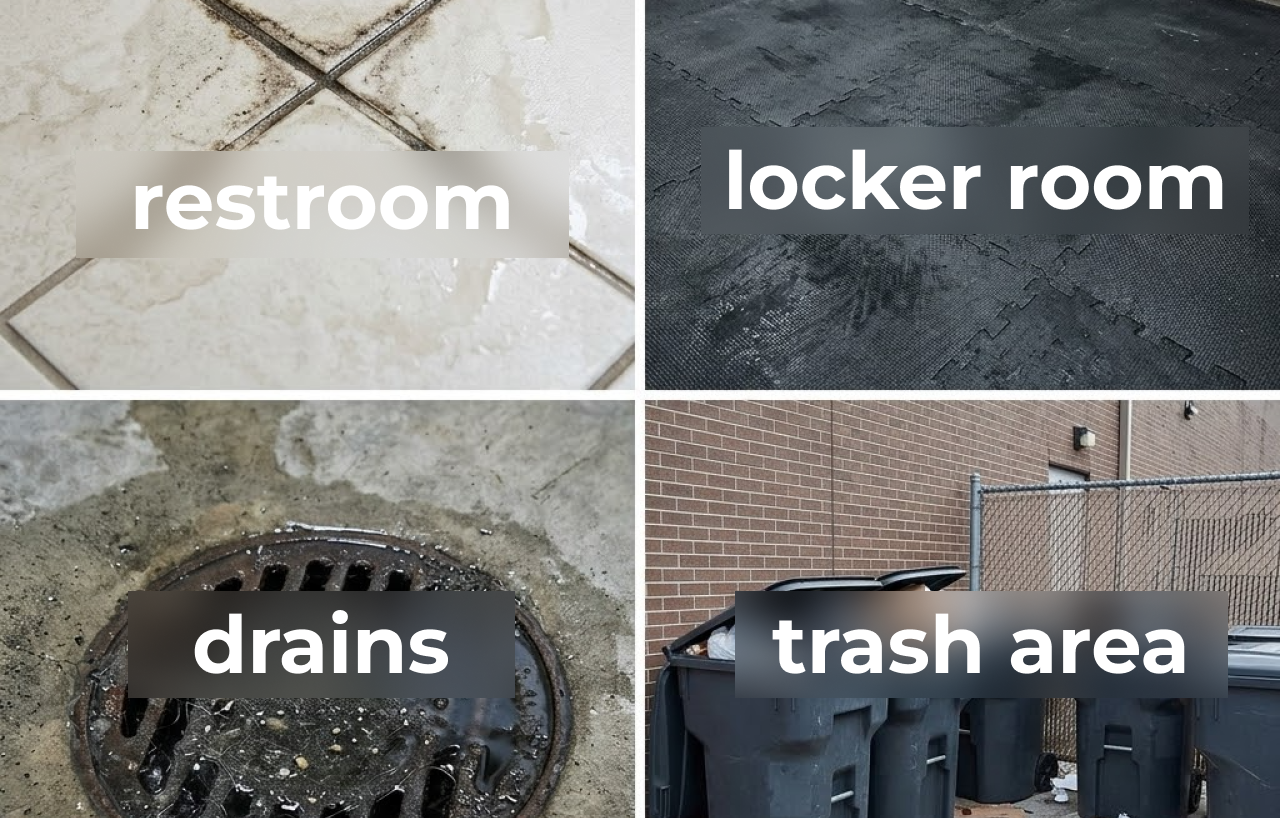
This matters most in restroom grout and around toilet bases, locker rooms with rubber flooring, trash rooms and dumpster areas, and carpeted zones exposed to spills or urine.
When to Use Enzyme Cleaners vs Disinfectants
The choice is not one or the other. It is about using them at the right stage of the cleaning process.
- Use disinfectants when you need to meet hygiene or inspection requirements, you are cleaning high-touch surfaces such as door handles, flush valves, or equipment touchpoints, or you need fast, visible sanitation between uses.
- Use enzyme cleaners when odors keep returning after disinfecting, you are dealing with urine, sweat, vomit, or food waste, or surfaces are porous and hold residue.
- Use both when cleaning restrooms, locker rooms, or trash areas, managing recurring odor complaints that do not resolve with more frequent disinfecting, or running multi-shift operations where odor builds between deep cleans.
Start with enzyme cleaning to break down the source, then disinfect to handle surface-level bacteria. Reversing that order limits effectiveness — the disinfectant seals in the residue, and the enzyme cannot reach it afterwards.
The Odor Control Protocol: Step by Step
Most odor problems in commercial facilities are not solved by cleaning more often. They are solved by cleaning in the right sequence. Follow this protocol in restrooms, locker rooms, trash areas, and any zone with recurring odor complaints.
- Clear visible debris. Remove trash, wipe up standing liquid, and sweep or dry-mop the area before applying any chemical.
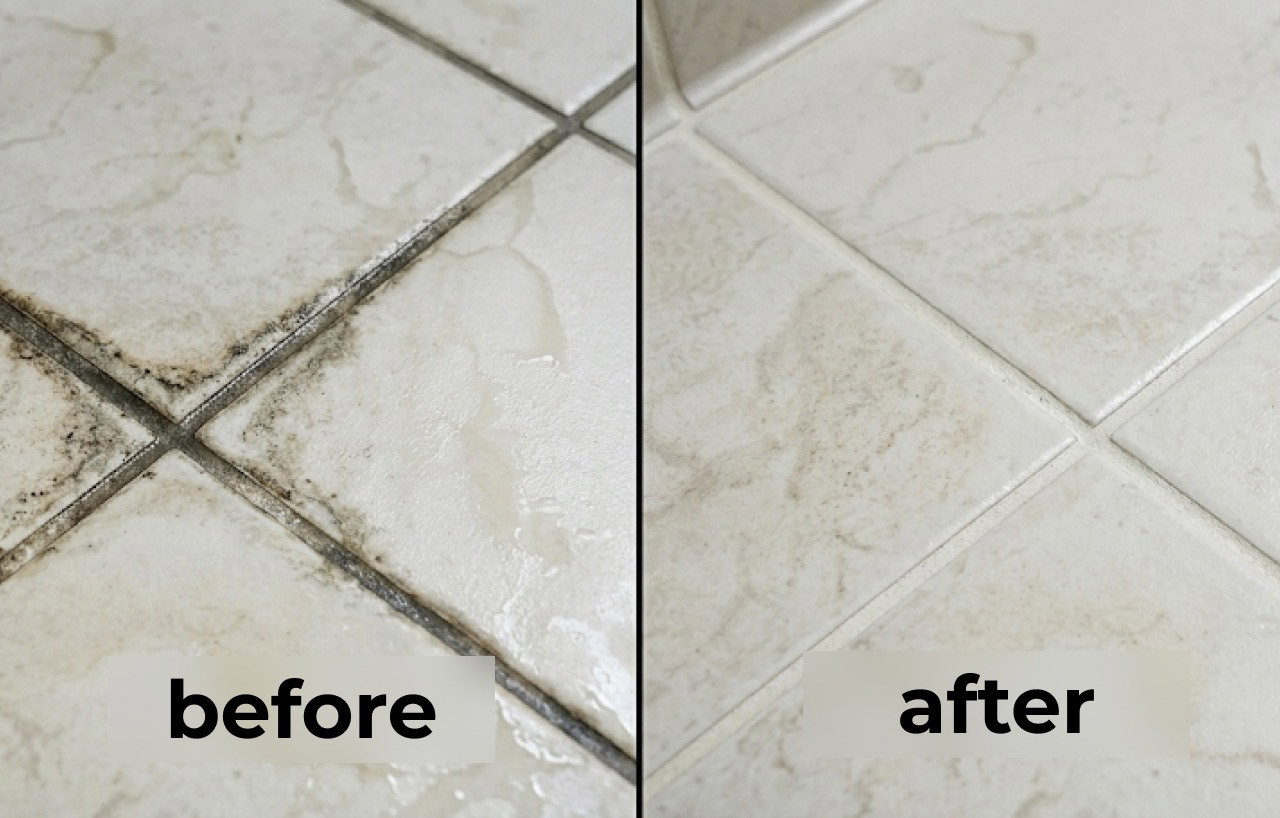
- Apply enzyme cleaner to odor-prone surfaces. Spray or mop onto grout lines, floor drains, toilet bases, urinals, and rubber flooring. These are the zones where urine salts, sweat proteins, and organic waste accumulate.
- Allow full dwell time. Enzymes work after application — do not mop up immediately. Follow product instructions; heavy buildup may require 5–10 minutes or a second application.
- Remove loosened residue. Mop or wipe away the broken-down waste. This step is what prevents odor from returning — the source is physically removed, not just sanitized over.
- Apply disinfectant for hygiene and compliance. Now that organic matter is removed, the disinfectant can reach the surface directly and perform as rated. Follow the contact time on the label.
Where Most Facilities Get It Wrong
The most common mistake is not cleaning frequency. It is sequence and product selection.
- Spraying disinfectant over unremoved buildup seals residue in place.
- Using general purpose cleaners on porous materials — grout, rubber flooring, unfinished concrete — leaves the odor source intact.
- Running high-frequency disinfecting schedules without enzyme treatment sanitizes the top of the problem without solving it.
The result is predictable: cleaning logs show full compliance, but occupants still report odors. Custodial staff clean the same zones repeatedly without a change in outcome. That is a workflow problem, not a staff problem, and it is fixed by matching product to surface chemistry rather than adding another cleaning pass. For a broader look at recurring facility cleaning issues, see top cleaning challenges facility managers face.
Choosing the Right Products for Odor Control
Product choice affects both results and labor time. Build the program in two layers: an EPA-registered disinfectant for compliance, and an enzyme cleaner for the odor sources it cannot reach.
For Daily Disinfecting
Use fast-contact, EPA-registered disinfectants that hold up in high-use areas. Diversey offers hospital-grade options trusted across commercial operations, including a ready-to-use all-purpose disinfectant cleaner, a concentrated one-step disinfectant, and a non-acid bowl and bathroom disinfectant.
For Odor Control
Use enzyme-based cleaners in problem zones where uric acid, sweat, and organic waste build up: toilet bases and urinals, floor drains and grout lines, trash bins and dumpster pads, locker room flooring, and unfinished concrete.
Zogics Enzyme Enriched Floor Cleaner & Deodorizer ($27.95 per gallon) uses live Bacillus subtilis cultures to break down organic waste on ceramic tile, quarry tile, grout, brick, and concrete while deodorizing.
Dilution Rates and Cost per Diluted Gallon
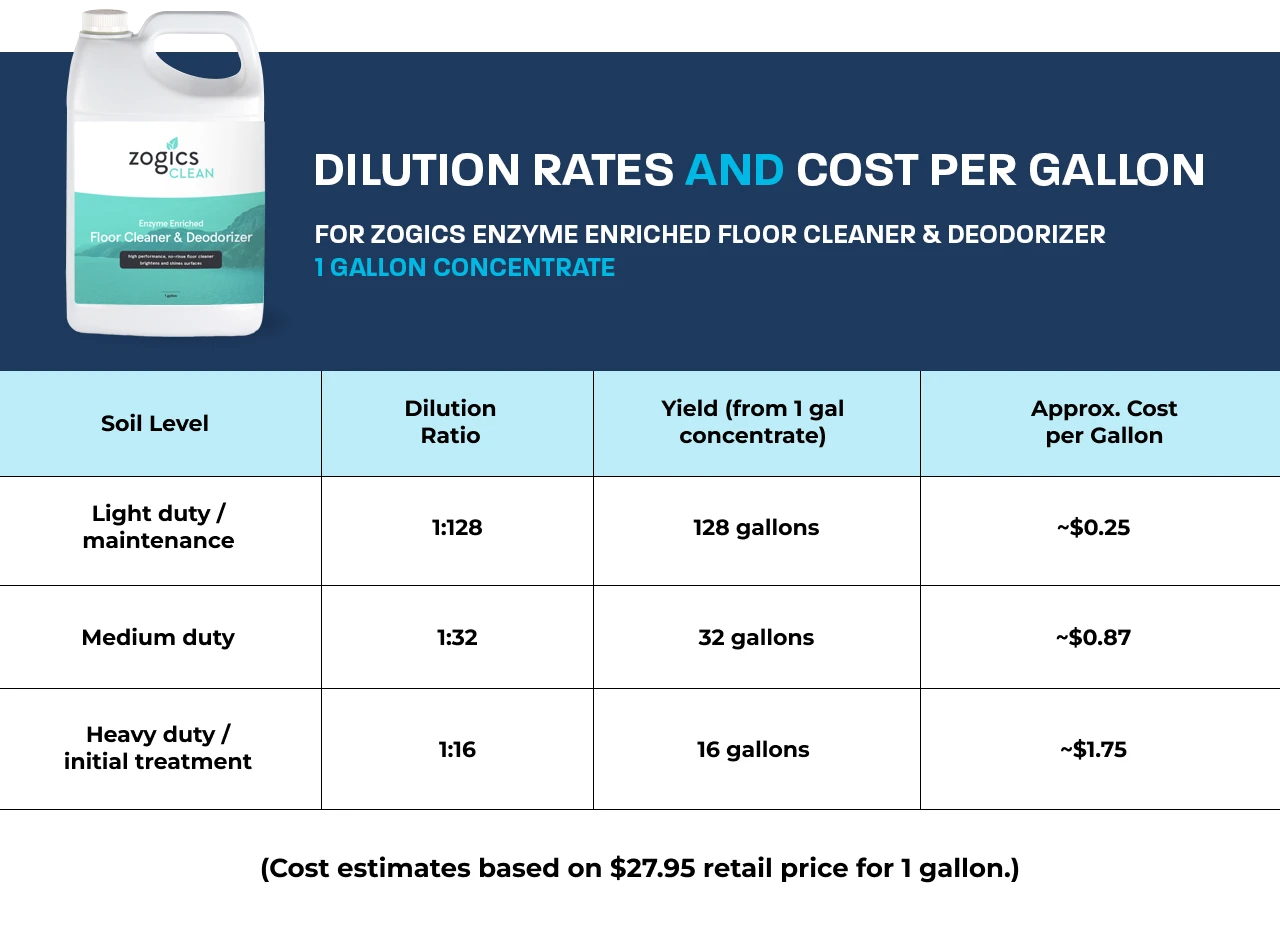
| Duty Level | Dilution | Diluted Gallons per Gallon of Concentrate | Cost per Diluted Gallon | Use It For |
|---|---|---|---|---|
| Light Duty | 1 oz per gallon | 128 | $0.22 | Routine maintenance once odor is under control |
| Light–Medium | 2 oz per gallon | 64 | $0.44 | Daily restroom and locker room floors |
| Medium Duty | 3–4 oz per gallon | 32–43 | $0.65–$0.87 | Grout lines, drains, and toilet bases |
| Heavy Duty | 6–8 oz per gallon | 16–21 | $1.31–$1.75 | First-time treatment on significant buildup |
Costs are calculated from the $27.95 gallon price and the dilution rates on the product label. Use heavy duty for first-time treatments or areas with significant buildup, then drop to a maintenance dilution once odor is under control.
For restroom deep cleaning, Zogics Organic Acid Restroom Cleaner cuts mineral deposits and uric acid scale. Pair it with enzyme treatment around bases and drains for full odor control.
Buyer's Checklist: Evaluating Cleaners for Odor Control
When comparing products, focus on performance under real conditions, not label claims.
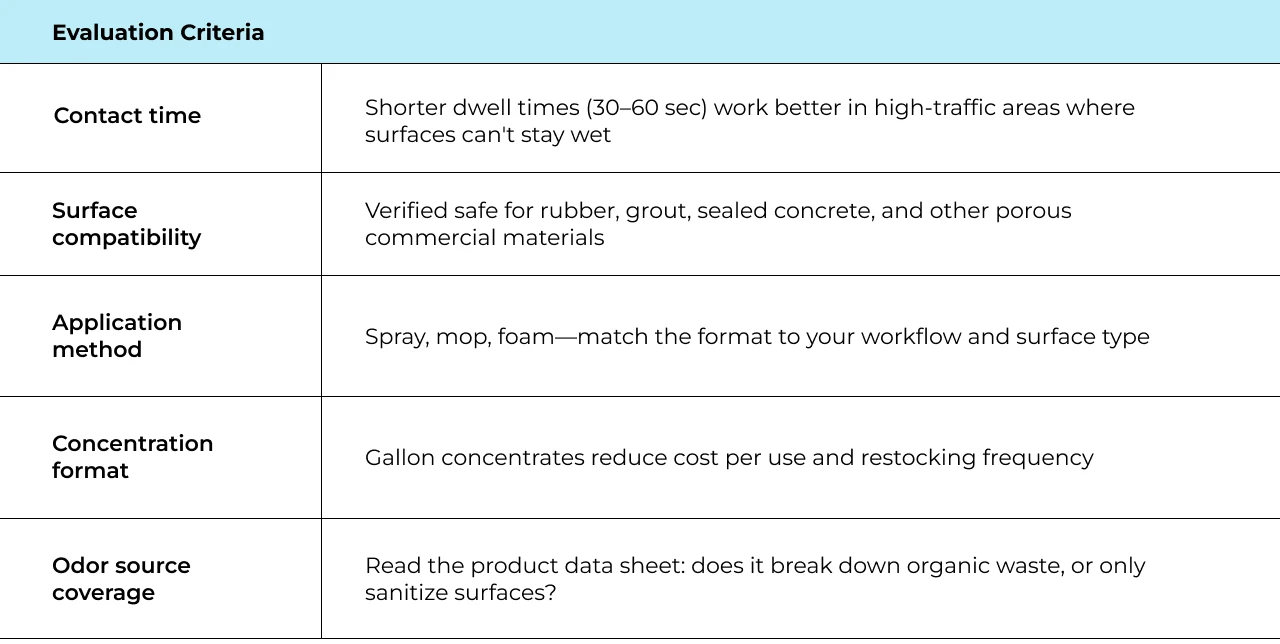
| What to Check | Why It Matters |
|---|---|
| EPA Registration Number | Present means it can legally claim disinfection. Absent means it is a cleaner, whatever the marketing says |
| Surface Compatibility | Most disinfectants are labelled for hard, non-porous surfaces only. Your odor is usually in a porous one |
| Dwell Time | A disinfectant that dries before its contact time has not disinfected. An enzyme needs time too |
| Dilution Rate and True Cost | Compare cost per diluted gallon, not per bottle. A concentrate can be 5–10x cheaper in use |
| Fragrance Load | Heavy fragrance masks odor rather than removing it, and hides whether the product is working |
| Labor Impact | A product that ends repeat cleaning of the same zone pays for itself in hours saved |
If odors keep returning after switching products, the issue is usually source removal, not disinfectant strength. You cannot kill your way out of an odor problem when the residue causing the smell is still on the surface.
Frequently Asked Questions
What is the difference between an enzyme cleaner and a disinfectant?
An enzyme cleaner digests organic residue such as urine salts, sweat proteins, and food waste. A disinfectant kills bacteria and viruses on the surface. Enzymes remove the source of odor; disinfectants control pathogens. Only the disinfectant is EPA-registered, and only it can be used for compliance.
Do enzyme cleaners disinfect?
No. Enzyme cleaners break down organic matter and can disrupt biofilm, but they are not tested or registered to kill pathogens to a defined standard. Under FIFRA, any product claiming to disinfect must be EPA-registered as an antimicrobial pesticide. Enzyme cleaners are not.
Do enzymatic cleaners disinfect?
No — enzymatic cleaner and enzyme cleaner are the same category, and neither disinfects. Both digest organic residue rather than killing microorganisms to a verified efficacy standard. Use an EPA-registered disinfectant when you need documented hygiene.
What is the source that says enzyme cleaners are not disinfectants?
The EPA, under FIFRA. Its guidance on determining whether a cleaning product is a pesticide states that claiming to sanitize, disinfect, or sterilize makes a product a regulated pesticide requiring registration. Deodorizing and removing organic soil are exempt claims, which is what enzyme cleaners are labelled for.
Which is better for odor, an enzyme cleaner or a disinfectant?
The enzyme cleaner, every time. A disinfectant kills germs on the surface but leaves the urine salts, sweat proteins, and food residue that are actually producing the smell. Remove the source and the odor does not return.
Can an enzyme cleaner replace a disinfectant?
No. It can reduce how much work your disinfectant has to do by removing the organic layer, but it cannot satisfy a hygiene requirement, an inspection, or any protocol that specifies disinfection. Use both.
Do you use enzyme cleaner before or after disinfectant?
Before. Apply the enzyme cleaner first to break down and remove organic buildup, then disinfect. Reversing the order seals residue under the disinfectant, and the enzyme cannot reach it afterwards.
Can you mix enzyme cleaner and disinfectant together?
No. Disinfectants are designed to destroy microorganisms and will denature the enzymes, so mixing them in one bucket neutralises the enzyme cleaner. Apply them as two separate steps with the residue removed in between.
Do enzyme cleaners kill bacteria?
Not directly, and they are not permitted to claim they do. What research shows is that enzymes remove the biofilm and organic residue bacteria live in, which lowers bacterial counts indirectly. A 2026 study reported an 83% reduction in biofilm matrix from an enzymatic treatment.
How long do enzyme cleaners need to sit?
Follow the product label, but plan on at least 5–10 minutes on heavy buildup, and do not mop up immediately. Enzymes keep working after application, so removing them too early cuts the process short.
Are enzyme cleaners EPA registered?
Generally no, and they do not need to be. EPA registration is required for pesticidal claims such as disinfecting or sanitizing. A product labelled only as a cleaner and deodorizer is exempt — which is why the absence of a registration number tells you it is not a disinfectant.
Building a Commercial Odor Eliminator System That Works
Facilities that rely on disinfectants alone end up cleaning the same areas repeatedly without solving the problem. Staff get frustrated when their work does not produce results. Occupants complain. Management sees cleaning logs showing everything completed on schedule, but cannot explain why the smell persists.
Adding enzyme cleaning where it matters — restroom bases, drains, locker rooms, trash areas — reduces odor complaints and cuts repeat labor. When both products are used correctly and in the right order, cleaning becomes more predictable and easier to manage across shifts and locations.
We provide commercial cleaning supplies, disinfectants, enzyme cleaners, and facility solutions for gyms, schools, healthcare facilities, and multi-location operations. Which zone in your building is the one that never quite smells clean? Contact our team and we will match products to your facility type and traffic volume.