Help Center

Quick Answer
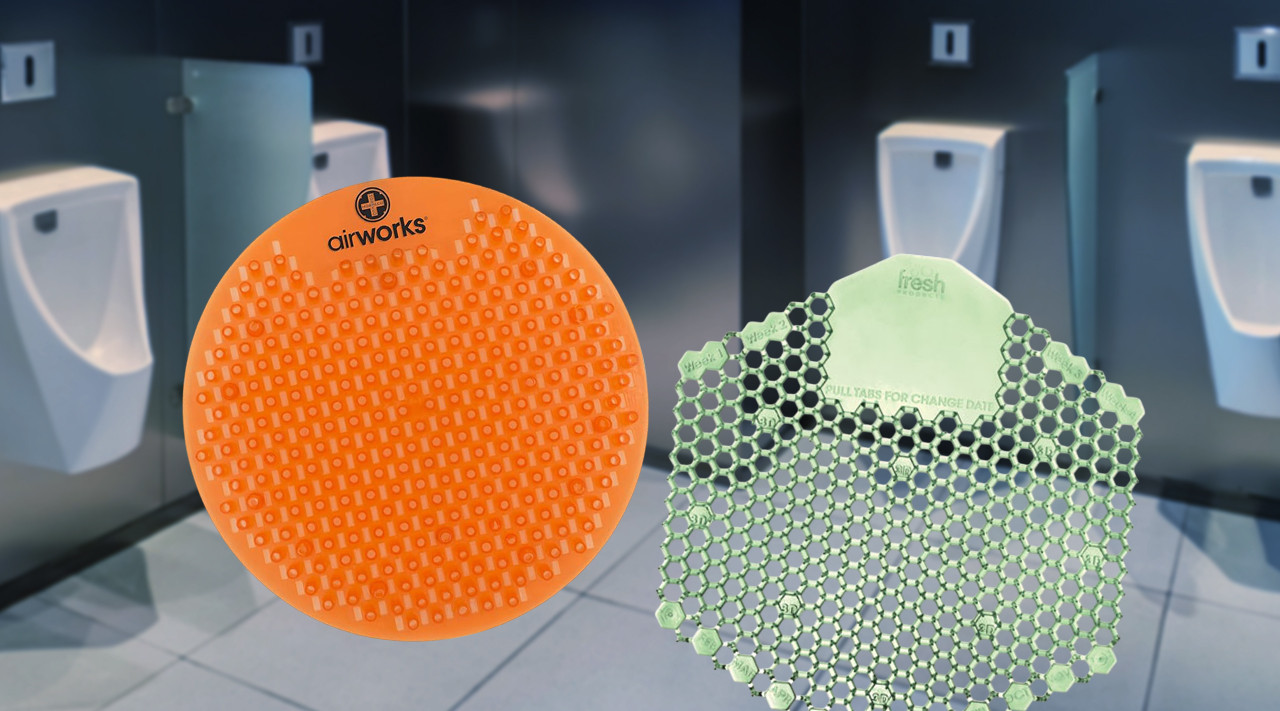
What It Is: A flexible mat placed over a urinal drain that traps debris, reduces splashback, and releases deodorizer.
What It Does: Prevents clogs, controls odor at the source, and keeps the floor around the urinal dry.
How Often to Change It: Every 30 days in most facilities, sooner in high-traffic restrooms.
How to Install It: Lay it flat over the drain. No tools, no adhesive, about five seconds.
What It Costs: Roughly $28–$36 per urinal per year at a 30-day replacement cycle.
A urinal screen is a small, flexible mat that sits over a urinal drain to trap debris, cut splashback, and release a deodorizer that neutralizes odor-causing bacteria. It is one of the cheapest pieces of restroom equipment you can buy and one of the few that pays for itself by preventing plumbing calls.
This guide covers what a urinal screen does, how it works, the types available, how often to replace one, and what a screen program actually costs per urinal per year.
What Is a Urinal Screen?
A urinal screen is a perforated mat, usually made of flexible vinyl or EVA, that lies flat across the bottom of a urinal over the drain. It performs four jobs at once: it catches solid debris before it reaches the plumbing, it breaks up the stream to reduce splashback, it releases fragrance, and in many models it delivers enzymes that break down uric salts.
Urinal screens are sometimes called urinal mats or urinal deodorizer screens. They are not the same thing as urinal cakes or blocks — see the comparison table below.
What Is the Purpose of a Urinal Screen?
The purpose of a urinal screen is to stop three problems before they start: clogged drains, restroom odor, and a wet floor. A $3 screen prevents all three, which is why they are standard issue in commercial restrooms.
| Purpose | What It Prevents | Why It Matters to a Facility |
|---|---|---|
| Clog Prevention | Gum, wrappers, cigarette butts, and uric salt buildup reaching the trap | A blocked urinal means an out-of-service fixture and a plumbing callout |
| Odor Control | Ammonia smell from bacteria breaking down urine | Restroom odor is the complaint customers remember and mention in reviews |
| Splashback Reduction | Urine reaching the floor, walls, and the user's shoes and trousers | Floor-level urine is the actual source of most persistent restroom odor |
| Hygiene | Bacteria colonizing the drain and surrounding floor | Less mopping, less chemical use, fewer complaints |
| Cleaning Efficiency | Time spent scrubbing and deodorizing | Fresh Products states its Wave 3D screen can cut cleaning time by up to 50% |
How Do Urinal Screens Work?
A urinal screen works in four ways at once: it filters, it deflects, it fragrances, and it digests. The filtering and deflecting are mechanical — they come from the shape of the screen. The fragrance and enzyme action are chemical, and they are what run out after about 30 days.
- Traps debris. The perforated surface catches gum, wrappers, and cigarette butts before they reach the drain, while still letting liquid pass freely.
- Reduces splashback. Raised tines, bobbles, or micro-tubes break the incoming stream and change the angle at which liquid meets the surface. See the physics below — angle is the whole game.
- Releases fragrance. The screen material is impregnated with fragrance that releases gradually as air and liquid move across it.
- Breaks down bacteria. Enzyme-treated screens digest the uric salts that cause both the ammonia smell and the hard scale that eventually blocks a urinal trap.
The Physics of Splashback: What 2025 Research Found
Splashback is governed by the angle at which the stream hits the surface, not by force. Research published in PNAS Nexus in April 2025 found that when the stream meets a surface at less than 30 degrees, splashback drops to about 1.4% of what a conventional urinal produces. Redesigned urinal geometries in the same study cut splashback by 85–95% under high-splash conditions.
The study, by researchers at the University of Waterloo and Weber State University, tested urinal shape rather than screens. But the finding explains exactly why anti-splash screens are built the way they are: tines, bobbles, and micro-tubes exist to break a steep, high-energy stream into shallow-angle contact. That is the same mechanism, applied to a $3 consumable instead of a replacement fixture.
The practical takeaway for facility managers: if your restroom has a persistent floor odor that survives daily mopping, the source is almost certainly splashback, not the drain. An anti-splash screen is the cheapest intervention available.
Source: Splash-free urinals for global sustainability and accessibility, PNAS Nexus, April 2025.
Types of Urinal Screens Compared
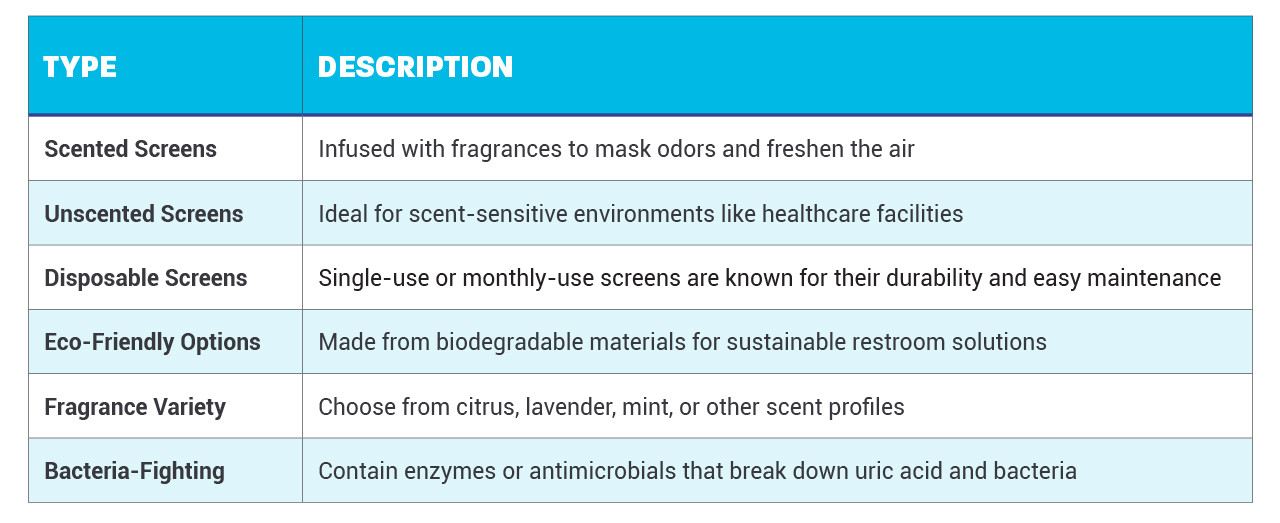
There are four formats to choose between: standard deodorizer screens, anti-splash screens, screen-and-block combinations, and enzymatic blocks. Anti-splash screens are the right default for most commercial restrooms.
| Type | How It Works | Best For | Example |
|---|---|---|---|
| Standard Deodorizer Screen | Flat perforated mat with fragrance impregnated in the material | Low- to medium-traffic restrooms where odor is the main concern | Fresh Products Wave 3D |
| Anti-Splash Screen | Raised tines or micro-tubes break the stream and cut splashback | High-traffic restrooms, and anywhere floor odor persists after mopping | Impact Eclipse Dual-Sided |
| Enzymatic Screen | Adds enzymes that digest uric salts rather than masking the smell | Older plumbing, hard water, or urinals with a history of scale buildup | AirWorks Splash Free |
| Urinal Block or Cake | A solid puck that dissolves over time. Deodorizes but does not filter debris or stop splash | Supplementing a screen, not replacing one | Eco Fresh Non-Para Enzymatic Block |
Browse the full range of urinal screens or the wider odor control category to build a restroom order.
How to Use a Urinal Screen
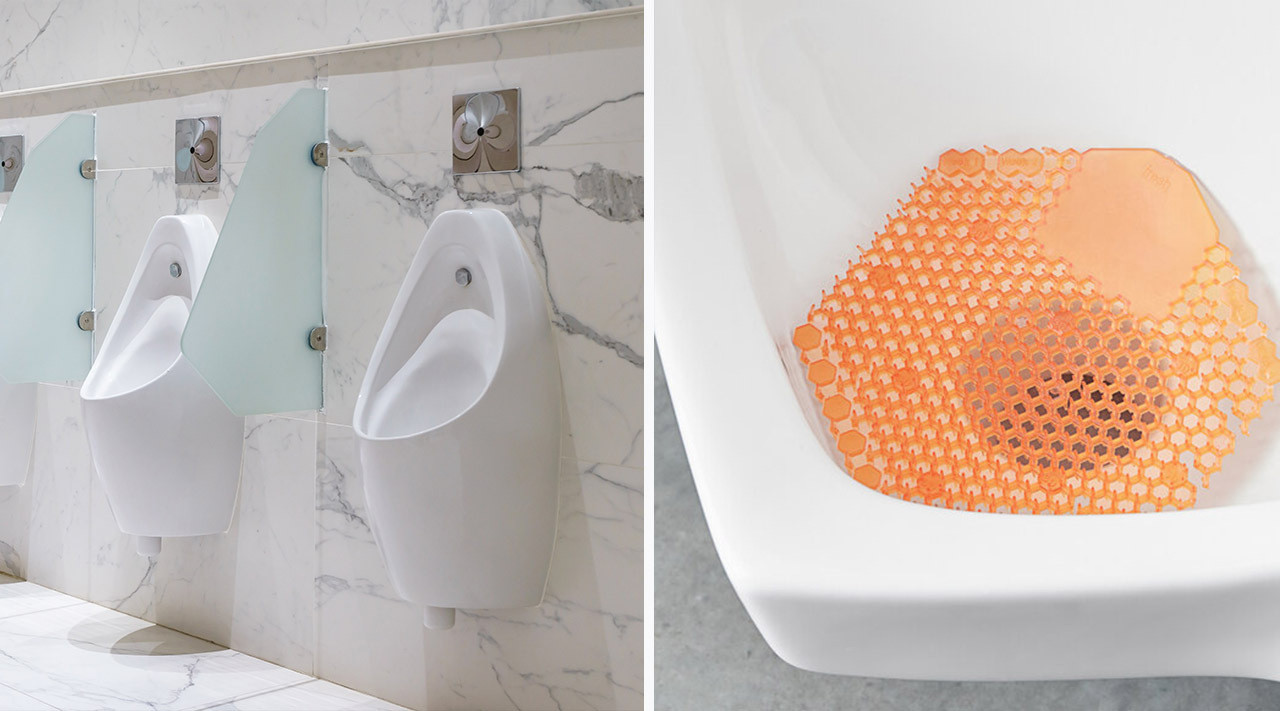
Lay the screen flat over the drain with the textured side facing up. There is no adhesive, no tool, and no fixing required — the screen sits under its own weight and the shape of the urinal bowl holds it in place. Installation takes about five seconds per urinal.
- Remove the old screen using a gloved hand or by tipping it into a bin. Do not flush it.
- Rinse or flush the urinal so you are placing a fresh screen onto a clean surface.
- Lay the new screen flat over the drain, textured or tined side up, centred on the outlet.
- Press the edges down so the screen sits flush against the bowl with no lifted corners.
- Write the date on your cleaning log, or use a screen with a built-in date indicator.
One thing to check first: some urinals hold standing water and some are dry or low-flow. Screens with raised feet, like the AirWorks Splash Free, are designed to work in both. A flat screen in a standing-water urinal can float or shift.
How Often Should You Change Urinal Screens?
Every 30 days for most commercial restrooms. That is the rated fragrance life of the major screens on the market — Fresh Products Wave 3D and Impact Eclipse both specify 30 days. In very high-traffic restrooms, replace at three weeks. If the fragrance is gone, the screen is spent even if it still looks fine.
| Restroom Traffic | Replacement Interval | Screens per Urinal per Year | Typical Setting |
|---|---|---|---|
| Very High | Every 3 weeks | ~17 | Stadiums, airports, transit hubs, event venues |
| High | Every 30 days | 12 | Restaurants, bars, gyms, schools, large offices |
| Moderate | Every 30 days | 12 | Small offices, retail, medical practices |
| Low | Every 30–45 days | 8–12 | Warehouses, low-occupancy sites |
Three signs a screen is due regardless of the calendar: the fragrance has faded, debris is visible on the surface, or the screen has curled at the edges. Do not stretch a screen past the point where the fragrance is gone — once the deodorizer is spent, you have a debris filter and nothing more.
Zogics Cost Analysis: What Urinal Screens Cost per Urinal per Year
A urinal screen program costs roughly $28 to $36 per urinal per year at a 30-day replacement cycle. For a facility with 10 urinals, that is $277 to $359 a year — less than a single after-hours plumbing callout for a blocked urinal.
How we calculated this: prices are Zogics list prices from live product pages on August 17, 2026. Cost per screen = pack price ÷ screens in the pack, using counts confirmed on each product page. Annual cost assumes 12 replacements per urinal per year, the standard 30-day cycle.
| Product | Pack Price | Screens | Cost per Screen | Per Urinal per Year |
|---|---|---|---|---|
| Impact Eclipse Anti-Splash | $82.95 | 36 per case | $2.30 | $27.65 |
| AirWorks Splash Free | $25.95 | 10 per pack | $2.60 | $31.14 |
| Fresh Products Wave 3D | $29.95 | 10 per box | $3.00 | $35.94 |
Scaled up, the numbers stay small. A 10-urinal facility spends $277 to $359 a year. A 50-urinal facility spends $1,383 to $1,797. Against that, one blocked urinal takes a fixture out of service, needs a plumber, and generates exactly the kind of complaint that ends up in an online review.
Maintenance Guidelines
Screens reduce cleaning work but do not replace it. Keep the daily routine and use the screen as the layer that stops problems between cleans.
- Clean and flush urinals daily even with screens in place, to keep flow clear and prevent buildup.
- Inspect screens during each clean for trapped debris, curling, or fading fragrance.
- Replace on schedule rather than on appearance — fragrance runs out before the screen looks used.
- Pair with an enzymatic block for extra freshness in problem restrooms, but treat the block as a supplement, not a substitute.
- Keep a spare box on site so a spent screen is replaced the same day it is spotted.
Common Mistakes to Avoid
- Leaving screens in too long. The single most common mistake. Once the fragrance is gone the screen stops doing its main job, and trapped debris starts feeding bacteria instead of blocking them.
- Using a flat screen in a standing-water urinal. It floats and shifts off the drain. Use a screen with raised feet.
- Cleaning screens with harsh chemicals. Solvents and strong acids degrade EVA and vinyl, and can strip the fragrance early. Screens are consumables, not equipment.
- Treating a block as a replacement for a screen. A block deodorizes. It does not filter debris or reduce splash.
- Skipping the daily clean because screens are installed. Screens buy you margin, not exemption.
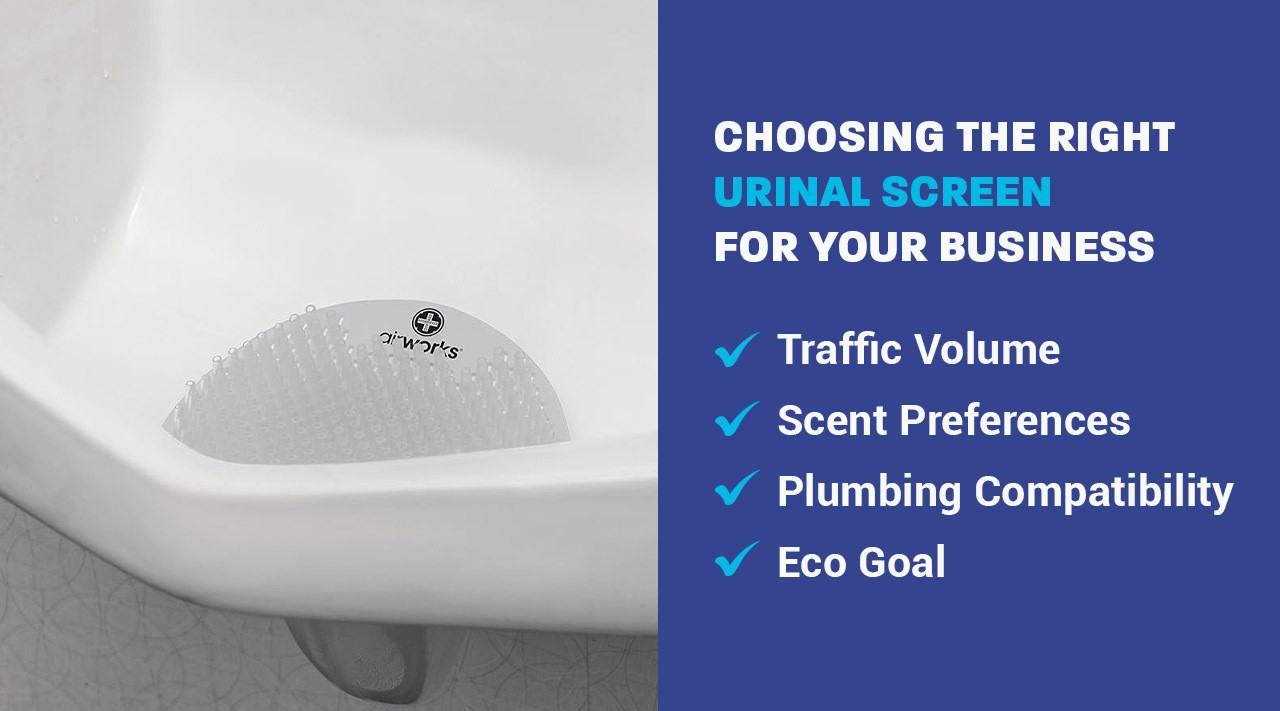
Choosing the Right Urinal Screen for Your Business
Match the screen to your traffic level and your urinal type first, then choose a scent. Anti-splash is the feature that matters most in busy restrooms; fragrance is the one that matters most in customer-facing ones.
- Traffic Volume: High-traffic restrooms need strong deodorizing power and anti-splash tines, and should be on a strict 30-day cycle.
- Urinal Type: Standing-water, low-flow, and waterless urinals all behave differently. Screens with raised feet suit both dry and standing-water fixtures.
- Scent Preferences: Choose scented for customer-facing restrooms. Go unscented or low-fragrance in healthcare, food preparation, and fragrance-sensitive environments.
- Odor Source: If the smell is at floor level, prioritize anti-splash. If it comes from the drain, prioritize enzymes.
- Eco Goals: Look for non-para formulations, which avoid paradichlorobenzene, if sustainability is part of your standards.
Environmental Considerations
The main environmental decision with urinal screens is the chemistry, not the plastic. Older urinal deodorizers used paradichlorobenzene, a substance many facilities now avoid. Non-para and enzymatic products do the same job without it.
- Choose non-para formulations where you can — several of the blocks and screens in the range are labelled this way.
- Enzymatic screens reduce the need for harsh drain chemicals, because they digest uric scale rather than dissolving it.
- Anti-splash screens cut floor cleaning, which reduces both water and cleaning chemical use. This is the sustainability benefit that gets overlooked.
- Buy by the case rather than the pack to cut packaging and shipping per screen.