Help Center

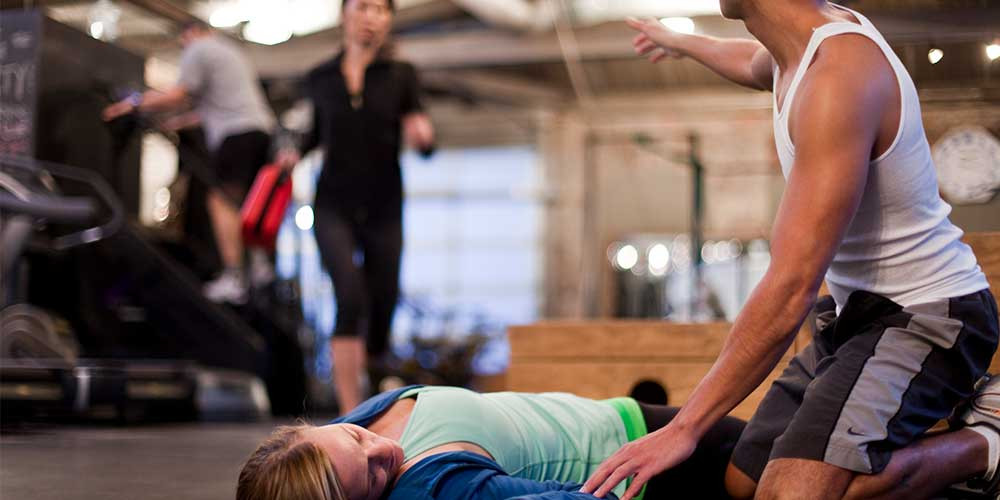
A gym is one of the few places where people deliberately push their bodies to the limit — and where a medical emergency is statistically more likely than in an office of the same size. Knowing exactly what first aid equipment your facility needs, and who is trained to use it, is the difference between a scare and a tragedy.
This guide covers the equipment, the training, the legal requirements, and the protocols that keep members safe — including the question most operators overlook: what happens during unstaffed hours.
Quick Answer
Minimum Equipment: An ANSI/ISEA Class A first aid kit, an AED, disposable gloves, and a bloodborne pathogen cleanup kit.
Recommended Upgrade: A Class B kit — it adds a tourniquet and splint for the injuries gyms actually produce.
Most Critical Item: The AED. Bystander AED use before EMS arrival raises cardiac arrest survival to about 15.5%, versus roughly 10% overall.
Legal Note: Roughly 14 states legally require AEDs in health clubs. Verify your state before assuming it is optional.
Unstaffed Hours: Wall-mounted AEDs in alarmed cabinets, duress buttons, and monitored cameras — a member cannot rely on staff who are not there.
What First Aid Equipment Fitness Facilities Actually Need
Direct answer: At minimum, a fitness facility needs an ANSI/ISEA Z308.1 compliant first aid kit, an AED with current pads and battery, disposable gloves, and a bloodborne pathogen spill kit. Most gyms are better served by a Class B kit than the basic Class A.
The ANSI/ISEA Z308.1-2021 standard defines two classes of workplace first aid kit. The distinction matters for gyms because the default assumption — that a basic office kit is enough — does not survive contact with a weight room.
| Kit Class | Designed For | Key Contents | Right For A Gym? |
|---|---|---|---|
| Class A | Low-risk settings — offices, retail, schools | Bandages, gauze, antiseptic, burn treatment, eye wash, foil blanket | Bare minimum — acceptable for small studios |
| Class B | Higher-risk, higher-population environments | Everything in Class A in larger quantities, plus a tourniquet and splint | Recommended for most full-service gyms |
The 2021 revision of the standard added tourniquets and splints to Class B kits and made foil blankets mandatory in both classes. Those two additions map directly onto gym injuries: a splint for the joint injuries that come from dropped weights and rolled ankles, a tourniquet for the rare but real deep laceration from equipment contact.
Beyond the kit itself, a fitness facility should stock:
- A compliant first aid kit mounted in a marked, unlocked location
- An AED with in-date pads and battery
- Disposable gloves and PPE at every kit location
- Instant cold compresses — the single most-used item in any gym kit
- Bandages and dressings in volume, since these deplete fastest
- A bloodborne pathogen cleanup kit for blood and body fluid spills
- Safety signage marking AED and first aid locations
The most common failure is not absence — it is depletion. A kit that was compliant when installed is often missing half its bandages and all its cold packs a year later. Stocking first aid refills and assigning a named person to a monthly check is what keeps a kit functional rather than decorative.
Crisis Management Equipment for Fitness Enthusiasts and Facility Operators
Direct answer: Crisis management equipment goes beyond the first aid kit to cover cardiac events, severe bleeding, and communication — an AED, a bleeding control kit, an emergency contact system, and clear signage directing anyone to all three.
First aid handles the scrapes. Crisis management handles the events that can kill someone in minutes. The distinction matters because the two require different equipment, different placement, and different training.
| Emergency Type | Equipment Needed | Time Window |
|---|---|---|
| Sudden Cardiac Arrest | AED, CPR barrier mask, phone access | Minutes — survival drops sharply each minute |
| Severe Bleeding | Tourniquet, trauma dressing, gloves | Minutes |
| Heat Illness | Cold compresses, water, shaded rest area | Tens of minutes |
| Fractures And Sprains | Splint, elastic wrap, sling, cold compress | Not immediately life-threatening |
| Blood Spill Exposure | PPE, biohazard cleanup kit, disinfectant | Contain immediately, clean thoroughly |
Blood spills deserve a specific note. After the person is cared for, the surface still needs proper decontamination — not a wipe-down with whatever is on the cart. Our guide to cleaning gym equipment covers dwell times and surface compatibility, which apply directly to bloodborne pathogen cleanup.
Why the AED Is the Most Important Equipment in Your Gym
Direct answer: An AED is the only piece of equipment in a fitness facility that reliably reverses a fatal event. Roughly 356,000 out-of-hospital cardiac arrests occur in the U.S. each year with about a 10% survival rate — but when a bystander applies an AED before EMS arrives, survival to hospital discharge rises to about 15.5%.
Exercise does not cause sudden cardiac arrest, but exertion can trigger it in people with undiagnosed underlying conditions. That is why gyms — full of people at peak exertion, many of them middle-aged and returning to fitness after years away — see cardiac events at a rate their square footage would not predict.
The Sudden Cardiac Arrest Foundation and the CARES registry both make the same point in different ways: the equipment works, and the limiting factor is whether anyone reaches it in time. Bystander CPR was initiated in only about 41.7% of cardiac arrest cases in the most recent CARES data. The gap is not technology. It is readiness.
AED requirements are also increasingly a legal matter. Roughly 14 states — including California, New York, Illinois, Massachusetts, New Jersey, Pennsylvania, and Michigan — legally require AEDs in health clubs, often with additional mandates around trained staff and filed emergency plans. Illinois, for example, requires a filed medical emergency plan alongside the device itself.
Requirements change, and the details vary considerably by state. Check the Sudden Cardiac Arrest Foundation's CPR and AED law summary for your jurisdiction, and confirm with your state health department before treating an AED as optional.
AED Maintenance: What Actually Fails
An AED that has not been checked is a liability, not an asset. Two consumable components expire on a schedule most facilities forget.
| Component | Typical Lifespan | Check Frequency |
|---|---|---|
| Electrode Pads | 2-5 years depending on model | Monthly visual, replace at expiry |
| Battery | 4-7 years depending on model | Monthly status indicator check |
| Status Indicator | Continuous self-test | Weekly glance — takes five seconds |
| Cabinet And Signage | Indefinite | Confirm unobstructed monthly |
Keep spare AED pads and batteries on hand rather than ordering them after expiry — a unit waiting on a part is a unit that does not work. Mounting the device in an alarmed wall cabinet protects it while making it visible and reachable.
How Do Unstaffed Gyms Handle Emergencies?
Direct answer: Unstaffed gyms handle emergencies through equipment and systems rather than people — highly visible AEDs in alarmed cabinets, duress buttons throughout the floor, monitored cameras connected to a response service, and member agreements that set expectations clearly.
This is the fastest-growing segment in fitness and the least-addressed in safety planning. A 24-hour access model means that for many hours a week, the entire emergency response capability of your facility is whatever a member can reach and operate alone.
That changes the equipment calculus completely:
- Placement beats quantity. An AED behind a locked front desk is useless at 2 a.m. Devices must be in the open, signed, and reachable without a key.
- Duress buttons distributed across the floor. A member having a cardiac event cannot walk to the entrance. Fixed call points in the free-weight area, cardio deck, and restroom corridors matter more than one at reception.
- Monitored cameras with a live response path. Recorded footage documents an incident. Monitored footage interrupts one. Only the second saves anyone.
- Signage written for a panicking stranger. Not "AED" in small type — large, high-contrast directional signs readable from across the room.
- Member onboarding that covers emergencies. If members are your only responders during unstaffed hours, they need to know where the AED is before they need it.
Insurance is the sharp edge here. Operating 24-hour unstaffed access without disclosing it to your insurer can constitute a material misrepresentation and void coverage. Insurers commonly expect documented AED placement, a member-accessible emergency communication system, and recorded pre-opening inspection procedures. Confirm your policy explicitly covers unstaffed hours before you extend them.
Honest caveat: equipment does not fully substitute for staff. An unstaffed facility carries genuinely higher risk, and no amount of hardware makes it equivalent to a staffed one. What good equipment does is narrow the gap and demonstrate that you took reasonable care — which matters both for member safety and for how a claim is evaluated.
Top Emergency Care Training for Gyms
Direct answer: The baseline is CPR/AED certification for every staff member on the floor, with at least one person per shift holding a full first aid certification. American Heart Association and American Red Cross courses are the two most widely accepted.
Equipment without training is theater. An AED will talk a responder through the process, but the decision to grab it in the first five seconds only comes from having practiced.
| Certification | Covers | Who Needs It | Renewal |
|---|---|---|---|
| CPR/AED | Chest compressions, rescue breathing, AED operation | Every floor staff member and trainer | Every 2 years |
| First Aid | Wounds, fractures, burns, heat illness, shock | At least one person per shift | Every 2 years |
| Bloodborne Pathogens | Exposure control, PPE, spill decontamination | Anyone handling cleanup | Annually |
| Emergency Action Drills | Your facility's specific plan and layout | All staff | Quarterly practice |
Courses are available through the American Red Cross and the American Heart Association, both of which offer blended online-plus-in-person formats that work around shift schedules. OSHA 1910.151 requires trained first aid personnel when medical facilities are not in near proximity — which describes most gyms.
The quarterly drill is the item most facilities skip and the one that changes outcomes most. Certification teaches technique; a drill in your own building teaches people where things are and who does what.
Create an Emergency Action Plan
Direct answer: An emergency action plan assigns specific people to specific roles before an emergency happens — who calls 911, who retrieves the AED, who meets paramedics at the door, and who manages other members.
An EAP is not a binder. It is a set of decisions made in advance so nobody has to make them under stress.
- Assess your specific risks. Walk your floor and list what could realistically happen: cardiac events on the cardio deck, dropped weights in the free-weight area, slips near showers and the pool, heat illness in hot studios.
- Assign roles by position, not by name. "The front desk attendant calls 911" survives staff turnover. "Sarah calls 911" does not.
- Define the communication chain. Who calls emergency services, who notifies management, who speaks to members and family. Write down the actual phone numbers.
- Map evacuation routes. Primary and secondary exits, an outdoor assembly point, and confirmation that routes stay unobstructed — equipment creep blocks exits over time.
- Post the plan where staff can see it. Back office, front desk, and staff room. A plan nobody can find during an emergency is not a plan.
- Coordinate with local EMS. Invite them to walk your facility. They will tell you where your AED should be and how to get a stretcher to your second floor.
- Review it twice a year. After every drill and after any real incident, update what did not work.
First Aid Tips for Fitness Enthusiasts
Direct answer: Members can handle most gym injuries themselves with three habits — stop immediately when something feels wrong, apply cold to acute injuries, and never work through chest discomfort, dizziness, or shortness of breath.
Most gym injuries are minor and self-managed. A few are warnings.
Handle it yourself:
- Skin tears and abrasions from knurled bars or turf — clean, cover with a bandage, keep it dry
- Minor strains — stop the movement, apply a cold compress for 15-20 minutes, rest it
- Blisters — cover rather than pop, and reconsider your grip or footwear
- Bruises from dropped plates — cold compress, elevate if it is a limb
Stop and get help immediately:
- Chest pain, pressure, or tightness — including discomfort you want to dismiss as heartburn
- Dizziness, fainting, or unusual shortness of breath at a normal effort level
- A joint that will not bear weight, or an audible pop with immediate swelling
- Bleeding that does not slow after several minutes of direct pressure
- Confusion, nausea, or stopping sweating during hot-room training — signs of heat illness
The last one catches experienced people out. Skipping a warning sign because you are mid-set and do not want to lose the session is the single most common way a manageable problem becomes an ambulance ride.
If you train regularly, learn where your gym's AED is. You are far more likely to be the bystander than the patient — and bystander action is the variable that changes survival.
Your Facility Readiness Checklist
Run this quarterly. Any "no" is an action item.
| Check | What Good Looks Like |
|---|---|
| First Aid Kit Stocked | Full to ANSI spec, nothing expired, restock log current |
| AED Ready | Green status indicator, pads and battery in date, spares on shelf |
| Staff Certified | Every shift has CPR/AED coverage, certifications unexpired |
| EAP Current | Reviewed within 6 months, posted, roles assigned by position |
| Drill Completed | Practiced this quarter, findings written down and fixed |
| Exits Clear | No equipment creep blocking routes or the AED cabinet |
| Unstaffed Hours Covered | Duress buttons tested, monitoring active, insurer notified |